
Source: Hope returns to Maphisa . . . nursing school reopens after 20 years – herald
Liberty Mutamba libertymutamba17@gmail.com
For nearly 20 years, the classrooms at Maphisa District Hospital’s nursing training school stood empty. Desks gathered dust, notice boards faded, while outside, young people from Matabeleland South who dreamed of wearing a nurse’s uniform had to leave home, travel long distances, and compete for places in Bulawayo, Harare or beyond.
Today the silence is gone. The Maphisa District Hospital Nursing School has re-opened its doors, bringing with it renewed hope for rural youth, relief for families, and a tangible sign of the Second Republic’s push to decentralise services under President Mnangagwa’s Independence Legacy Projects.
The institution was officially spruced up and handed back to the province as part of the Government’s programme to revive and equip high-impact legacy facilities that were mothballed after independence.
It now joins Gwanda Multi-Disciplinary Provincial Hospital, Brunapeg and Tshelanyemba as fully functional health training institutions in Matabeleland South, with Plumtree District Hospital also in the pipeline.
Government officials and community members say the re-opening is more than the restoration of a building.
They say it is about correcting a historical imbalance, about ensuring that opportunities in education and health are not confined to big cities, but are distributed evenly to every district regardless of location.
“Devolution means taking services to the people,” said Matabeleland South Provincial Medical Director (PMD) Dr Andrew Muza in an interview.
“We are happy that Maphisa District Hospital will re-open its doors to a new crop of nurses, after 20 years of hiatus.
We are going through the paperwork of prospective candidates, and soon new nurses will be using the renovated facility.
“Now we have four fully functional training institutions in our province, with Plumtree District Hospital almost there. This transition will ensure that more people can benefit from these services instead of having to travel long distances.”
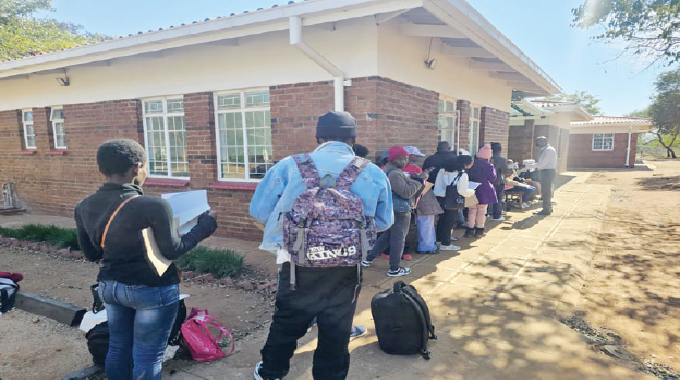
For applicants, the significance is personal; Miss Claudetter Ndlovu, 22, from Maphisa, has applied for nursing training three times. Each time she had to submit an online application and wait, uncertain if it had reached the right office.
“I have a passion for health care. This is my third year applying for this post. For the past years, I used to do online applications because we did not have any training institutions in our vicinity. Now the re-opening of this training institution has surely revived my hope. Physically handing in my application and having a face-to-face interaction rekindles my hope of being shortlisted,” she said.
Another applicant, Mr Nqobizitha Ndlovu, said the proximity of the school means young people can now train and return to serve their own communities.
“We are happy that the school is opening in our vicinity and our hopes are very high that we are going to be among the successful candidates because we will be serving our own people,” he said.
“In the past, we used to send applications online without knowing whether they had reached the final destination.”
For parents, the cost saving is immediate. Previously, fees, transport, accommodation and upkeep in distant cities had made nursing training out of reach for many households in Bulilima, Mangwe, Matobo and Gwanda districts.
Training at Maphisa means students can live at home, reducing the financial burden and increasing the chances that graduates will remain and work in Matabeleland South after qualifying.
The re-opening of Maphisa is part of a broader trajectory being pursued by the Second Republic. Since 2018, President Mnangagwa’s administration has emphasised “leaving no one and no place behind,” with Independence Legacy Projects targeted at reviving infrastructure that was built in the early years after 1980 but later fell into disuse due to funding constraints and migration of services to urban centres.
Across Matabeleland South, that agenda is visible where roads are being upgraded under the Emergency Road Rehabilitation Programme, clinics are being equipped, irrigation schemes are being revived, and now, health training institutions are being decentralised.
The logic is simple: if every province can train its own nurses, doctors, teachers and technicians, then service delivery improves, unemployment drops, and communities retain their skilled young people.
At Maphisa, the renovations included refurbishment of classrooms, hostels, ablution facilities, a skills laboratory, and the installation of modern teaching equipment.
In addition, the hospital itself will serve as the practical training site, giving students immediate exposure to patients and to the disease burden of a rural district that sits along the busy North-South Corridor.
Matabeleland South is a vast province with scattered settlements, long distances between facilities, and a history of outward-migration of health workers. For years, the province relied on three main training sites. That meant fewer training slots, and many local applicants were left out.
With Maphisa back online, the province now has four operational schools, with Plumtree expected to follow. That expansion directly increases the number of nurses that can be produced each year locally.
Beyond numbers, there is a quality argument. Nurses trained in the communities they will serve tend to understand local languages, cultural practices, and health challenges better. They are more likely to stay, reducing the constant churn that rural clinics experience.
“This will strengthen healthcare delivery in Matabeleland South by training professionals who understand the needs of the communities they will serve,” said Dr Muza.
The impact is already being felt in anticipation, with district hospitals in the province now preparing to absorb students for clinical rotations.
Dr Muza noted that the paperwork is underway, and soon the first new cohort will begin classes in the renovated facility.
In addition, local businesses around Maphisa are expecting increased activity as students and lecturers return. And young people who had shelved their dreams are dusting off their certificates.
When Zimbabwe attained independence in 1980, one of the priorities was to expand access to health and education.
Rural hospitals, schools and training colleges were built across the country. Over time, however, many of those facilities were under-resourced.
The Independence Legacy Projects under President Mnangagwa are designed to return to that original vision, but with modern standards. The approach is not to build entirely new infrastructure from scratch in every district, but to rehabilitate what already exists, equip it, and staff it.
In Matabeleland South, that has meant a deliberate focus on equity. The province shares a border with South Africa and Botswana, and sees heavy cross-border movement. Health needs are therefore high, from maternal care to trauma management along major highways. Having more locally trained nurses helps the province respond faster.
Government has also reaffirmed its commitment to universal health coverage, with stronger collaboration between public and private sectors. The idea is that no Zimbabwean should be denied quality, safe and affordable healthcare because of where they live.
“Under the Independence Legacy Projects, the training institutions breathe life after several renovations, and it was spruced up to ensure that the new crop of trainees finds a viable home,” said a senior health official in the province.
For the students now queuing at Maphisa with their application forms, the re-opening represents a door that had been closed for two decades.
It is a chance to pursue a career without leaving home. It is a chance to become part of the next generation of healthcare workers transforming rural Zimbabwe.
The school’s return also sends a political message. That development is not only measured in highways and dams, but in classrooms that open, in young people who get a chance, and in services that come closer to the people.
In a province where distance has long dictated opportunity, Maphisa’s re-opening is a reminder that under the Second Republic, the map of development is being redrawn — one district hospital, one nursing school, one student at a time.
The message from Maphisa is clear. Independence was about freedom. The legacy projects are about making that freedom meaningful in everyday life, by bringing education, health and opportunity within reach of every Zimbabwean, no matter how rural, no matter how far from the capital.

« Solar power lights up lives in Mat South
Disabled teacher appeals for US$1 515 »