The ZIMBABWE Situation
An extensive and up-to-date website containing news, views and links related to ZIMBABWE - a country in crisis
Please note: You need to have 'Active content' enabled in your IE browser in order to see the index of articles on this webpage
IMF provides $510m loan for Zimbabwe amid worries that Mugabe party will
grab funds
• Move is another step in country's
rehabilitation
• MDC fears cash may be diverted to Zanu-PF
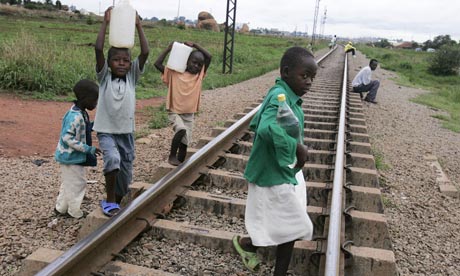
Children carry water collected from a stream in Budiriro
neighbourhood in Harare, Zimbabwe, Dec 17, 2008. Photograph: © Philimon
Bulawayo/Reuters
Zimbabwe's crippled
economy received a boost when the IMF sanctioned a $510m (£311m)
loan, its first to the country in a decade.
But the move stirred conflict between the partners in Zimbabwe's unity
government amid fears it would used to shore up President Robert Mugabe's
regime.
Gideon Gono, Zimbabwe's reserve bank governor, said the IMF had paid it $400m
via a fund for developing countries hit by the global recession, with a further
$110m to follow next week.
"I can confirm that the Reserve Bank of Zimbabwe did receive the funds," Gono
told the state-owned Herald newspaper, adding that he and the finance minister,
Tendai Biti, would discuss how to deploy the funds.
The money will be used to replenish Zimbabwe's dwindling foreign currency
reserves and has been released on condition it is not diverted to other
projects.
Political leaders hailed the decision as a sign that Zimbabwe's unity
government is ending the country's spell in the international wilderness.
The IMF wound down its programme there 10 years ago and formally withdrew in
2002, adopting a "declaration of noncooperation" with Mugabe's government.
Eddie Cross, an economist and policy co-ordinator for the Movement for
Democratic Change (MDC), said: "This is the first significant IMF involvement
with Zimbabwe for more than a decade.
"The magnitude is very substantial, about half our total budget this year.
It's a very large contribution."
But the MDC opposed Gono's appointment at the reserve bank and will be
anxious to ensure he does not control the funds in case they are directed to the
coffers of Mugabe's Zanu-PF party instead of the impoverished population.
"Gono is part of the reactionary elements fighting the unity government,"
said Cross. "He's been the principal culprit for the meltdown of the economy.
We've been successful in … circumventing him and that's what we'll do with this
money.
"It will be controlled very carefully, otherwise it will be used and abused
and find its way to all sorts of nefarious activities and corrupt
institutions."
Another MDC source added: "Gono has tried to take the money but Biti is
trying to take charge." The source added that Zimbabwe may be unable to draw
down the funds until it has shown it can repay a debt of $5.7bn to various
creditors. "The funds will come but it will be in the context of Zimbabwe having
committed to clearing these debts," he said.
The IMF told Zimbabwe two weeks ago, in a letter obtained by Reuters, that it
would not receive the $510m until it repaid arrears of $142.2m. In a letter to
Biti, the IMF's acting director for the African Department, Mark Plant, said
countries with arrears would not receive aid until they had cleared them.
"Thus, although Zimbabwe is eligible to receive the SDR (Special Drawing
Rights) under the general allocation, it will not receive its share under the
special allocation ... until its arrears have been cleared."
G20 leaders agreed in April
to treble to $750bn the IMF's capacity to help struggling economies. According
to the IMF's website, all 186 members were eligible to receive the money from 28
August in proportion to their existing quotas with the fund.
Zimbabwe has suffered a decade of economic meltdown and record
hyperinflation, worsened by the withdrawal of western aid over policy
differences with Mugabe's previous administration, before he formed the unity
government this year with rival Morgan
Tsvangirai.
Western donors have demanded broad political and economic reforms before
giving direct aid to the government. Donors currently provide only humanitarian
aid. Dominique Davoux, the EU's head of economic co-operation and food security
in Zimbabwe, told a business conference in Harare this week that efforts to
restore ties were being made.
"Zimbabwe's international relations are on the mend, with bilateral and
multilateral re-engagement efforts taking centre stage, starting with the prime
minister's visit to Brussels in June," Davoux said. "It's moving very slowly and
we want it speeded up to deal with areas of concern on both sides."
Davoux said any possible financial assistance to the unity government -which
says it requires about $10bn to rebuild the economy – depended on successful
negotiations.
Biti warns
IMF loan unaffordable
http://www.iol.co.za
September 04 2009 at
08:08PM
Harare - The International Monetary Fund said on
Friday it had
allocated a $510-million loan to Zimbabwe, but finance
minister Tendai Biti
said the government cannot afford to take the
loan.
The allocation follows an agreement by the G20 group of the
world's
leading economies in April to increase to US$750-billion the IMFs
support to
economies stricken by the world recession.
But Biti
told German Press Agency dpa: "It's not a grant, its a loan.
It attracts
interest.
"We would be contracting debt when our balance of
payments and our
debt burden is very fragile. We have less than US$2 million
in import
reserves. Our arrears account for 150 percent of gross domestic
product.
"There is no way we can take that (loan) up in the context
of the
arrears and the deficit. It would be very imprudent."
The loan would have been the IMF's first payment to Zimbabwe since
1999,
soon after which President Robert Mugabe launched a campaign of
violent
repression, mass seizures of white-owned commercial farm land and
economic
policies that plunged the economy into chaos and saw the country
fall
steadily back on its payments to international creditors.
A
power-sharing agreement between Mugabe and Morgan Tsvangirai, his
pro-democracy opponent but now prime minister, was inaugurated in February
and Biti abolished the worthless national currency and introduced the US
dollar as legal currency.
The action promptly stabilised the
country's inflation rate of 80
billion percent a month, and filled
supermarket shelves that had been empty
for nearly a year. -
Sapa-dpa
Zimbabwe,
Madagascar to top SADC summit agenda
http://af.reuters.com
Fri Sep 4, 2009 3:24pm GMT
*
Regional summit to address Zimbabwe, Madagascar crises
* South Africa to
call for unified stance on Zimbabwe
* Congo to take over chairmanship of
the bloc
By Joe Bavier
KINSHASA, Sept 4 (Reuters) - Southern
African leaders will seek a united
position on ensuring implementation of
Zimbabwe's power-sharing deal at a
summit in Congo next week that will also
discuss Madagascar, the bloc's
other political crisis.
Heads of state
from the 15-nation Southern African Development Community
(SADC), which has
been leading efforts to resolve the crises, will also had
over chairmanship
of the regional body to host Democratic Republic of Congo.
The group will
seek a united position after Zimbabwe's Prime Minister Morgan
Tsvangirai
called on SADC to push President Robert Mugabe to fully implement
a February
agreement to end the country's political and economic crisis.
"The
important thing is that even now it is going to be important moving
forward
for SADC to act in unison," Ayanda Ntsaluba, South Africa's director
general
for international relations and cooperation, said at a briefing this
week.
"We could have easily still have been at a point now when we
would all be
saying, look, this thing is not working. It is a disaster.
Zimbabwe is
moving backwards. But, I am sure all of us would agree that we
are not at
that point, which is a major achievement on its own, given where
we have
been in the past."
Tsvangirai's MDC accuses Mugabe's ZANU-PF
of failing to honour an agreement
to reverse the appointments of political
allies to key posts. ZANU-PF has,
in turn, charged that the MDC has not
fulfilled its pledge to condemn
sanctions imposed by Western governments on
Mugabe and his inner circle.
Analysts expect South Africa's new President
Jacob Zuma to take a tougher
stance than his predecessor, Thabo Mbeki, in
seeking an end to the impasse
and years of turmoil that have pushed millions
of Zimbabweans to seek work
in South Africa.
However, South Africa's
efforts to put pressure on Mugabe at the summit
could meet resistance from
other regional governments, which, with the
exception of Botswana, have
largely shied away from openly criticizing the
Zimbabwean
president.
Former Mozambiquan President Joaquim Chissano has been tasked
with leading
talks on Madagascar, where Andry Rajoelina, a 35-year-old
former DJ, ousted
former President Marc Ravalomanana in a March
coup.
Chissano is expected to present a report on progress on the talks
during the
Sept. 7-8 meeting but it is unclear how much leverage the body,
which has
suspended the country's membership, has on the Indian Ocean
island's
political leaders.
Talks on Madagascar in Mozambique's
capital Maputo collapsed last week as
the parties failed to agree who should
hold the top jobs in a transitional
government.
Congo takes over
leadership of the group as it still struggles contain
continued fighting and
humanitarian crises in its east.
"I think if any one of us said (Congo)
is not going to struggle a bit, I
think we would be lying. It is a huge
responsibility," Ntsaluba said, adding
that Congo could benefit from the
experience. (Editing by David Lewis)
Sadc members for Zimbabwe USD 10 billion economic
plan
http://www.portalangop.co.ao
9/4/09
4:01 PM
Luanda
Luanda- The member countries of the Southern Africa
Development Community
(SADC) are supporting the Zimbabwean Economic Recovery
Emergency Programme.
The programme is estimated at USD 10
billion, of which USD 2 billion are
destined to cover the emergency and
immediate needs, in order to support the
budget and the credit lines in USD
one billion.
The intervention of SADC member States may
support Zimbabwe in budget,
credit lines, joint venture and manufacturing
under hiring.
Some countries such as Angola, South Africa,
Botswana, Mozambique, including
China have already responded to the need of
Zimbabwe, by supplying material
and financial
support.
Figures show that the Zimbabwean economy will grow
3.7 per cent, regarding
its Gross Domestic Product (GDP) in 2009 due to the
improvement that it is
foreseen in various sectors.
SADC
groups Angola, Botswana, Democratic Republic of Congo, Lesotho,
Madagascar,
Malawi, Mauritius, Mozambique, Namibia, Seychelles, South
Africa, Swaziland,
Tanzania, Zambia and Zimbabwe.
African
Commission rules Zimbabwe's AIPPA should be amended
http://www.swradioafrica.com/
By Violet Gonda
4
September 2009
The government is coming under fire after another African
body ruled against
it. News agencies this week focused on government
pull-out from the SADC
Tribunal that ruled in favour of white commercial
farmers. But earlier the
African Commission on Human and Peoples' Rights had
ruled that the
Zimbabwean government should repeal sections of the
repressive Access to
Information and Protection of Privacy Act. This
happened in June, after
complaints by the Media Institute for Southern
Africa-Zimbabwe, the
Independent Journalists Association of Zimbabwe and the
Zimbabwe Lawyers for
Human Rights.
A recent statement by MISA
Zimbabwe said: "The complainants challenged the
constitutionality of the
requirements compelling journalists to be
accredited, criminalisation of
offences relating to abuse of journalistic
privileges and statutory
regulation of the profession." The Zimbabwean
government unsuccessfully
argued that there was nothing prejudicial with the
registration and
accreditation of journalists, that the right to freedom of
expression was
not absolute and that the practice of journalism did not
place it beyond
statutory regulation.
The MISA statement goes on to say: "The government has
since amended AIPPA,
only to replace it with yet another statutory body in
the form of the
Zimbabwe Media Commission and in terms of Constitutional
Amendment No 19 of
2008. This is in breach of the provisions of the African
Charter which
states that self-regulation is the best system of effecting
professionalism
in the media."
Observers say Mugabe and his hard liners
are now clearly showing that they
will abide by no rule, of any law, be it
Zimbabwean or African.
MDC
says cabinet not consulted about SADC Tribunal pullout
http://www.swradioafrica.com/
By Violet Gonda
4
September 2009
On Wednesday the state controlled Herald newspaper
reported that Justice
Minister Patrick Chinamasa had delivered a letter to
the Registrar of the
SADC Tribunal, to formally withdraw Zimbabwe from any
legal proceedings
involving the regional court. Chinamasa said: "There was
never any basis
upon which the Tribunal could seek or purport to found
jurisdiction on
Zimbabwe, based on the Protocol which has not yet been
ratified by
two-thirds of the total membership of SADC."
It is widely
believed that this is happening because ZANU PF is very unhappy
with recent
Tribunal decisions, in favour of white commercial farmers who
are fighting
against the acquisition of their farms by the government.
But on Friday
the MDC said it was not aware that a decision to pullout of
the Tribunal had
been made. Godern Moyo, the Minister of State in Prime
Minister Morgan
Tsvangirai's office, told SW Radio Africa he only heard
about it in the
press, and revealed that neither the Prime Minister nor the
cabinet were
consulted on the issue.
Moyo said: "The proper procedure of government,
if a decision of that
gravity had to be taken, that decision had to be taken
either through the
Council of Ministers or through cabinet and I was in the
last two/three
cabinet meetings. I was there and nothing of that nature was
brought to the
attention of cabinet to make a decision."
"You are
talking about the policy of government in relation to other
countries, more
so in relation to the sub-region, and all members of
government should be
aware of that and should be consulted on such issues
and we are not aware
ourselves."
The Minister said until there is proper communication on this
matter by the
Justice Minister 'to me it remains something that is not
true.it's too
ghastly to be true."
The MDC said it expected all
members of the coalition government to act in
unison and bring important
issues to the cabinet or the Principals. "The
Principal that I work with is
not aware of that," added Moyo.
Meanwhile a legal opinion by lawyers, who
took the cases of the commercial
farmers to the Tribunal, dismissed
Chinamasa's move saying it was 'lacking
of any legal
foundation.'
South African lawyers Jeremy Gauntlett, F B Pelser and
constitutional law
expert Professor Jeffrey Jowell, said: "There is no bona
fide basis for the
contention that the rulings by the Tribunal do not bind
the Government of
Zimbabwe."
The barristers said Zimbabwe is a
signatory to the SADC treaty and the
Protocol setting up the SADC Tribunal,
in terms of article 16(2) of the
Treaty, is binding on all SADC members,
rendering ratification unnecessary.
Despite scores of commercial farmers
being given temporary relief to stay on
their farms by the Tribunal,
disruptions continue in Zimbabwe in serious
breach of the ruling. A second
ruling showing the Zimbabwe government in
contempt has also been
ignored.
The regional court has now asked its parent body to consider
enforcement
against Zimbabwe, at the forthcoming SADC summit in the DRC.
US
Embassy slams Herald for "false report"
http://www.thezimbabwetimes.com/?p=22221
September 4, 2009
By Our
Correspondent
HARARE - The US embassy has slammed the State-run Herald
newspaper for
"inaccurate and irresponsible" reporting of a visiting
delegation of US
congressman.
The Herald report rubbished the visit
by the delegation of US congressmen,
who concluded two days of meetings with
senior Zimbabwean government
officials in Harare Thursday.
In a
report under the heading "US Congressional team's visit raises
eyebrows,"
the paper claimed that the motive of the congressmen had been
questioned
following their "impromptu last-minute call on President Mugabe
at State
House yesterday just as they made their way to the airport," an
assertion
vehemently rejected by the US embassy.
The embassy advised that as a
matter of fact, all diplomatic channels had
been followed and the request
for the meeting with the Presidet had been
done well in advance.
The
Herald claimed the visiting US delegation had "apparently not planned to
meet President Mugabe and had only scheduled appointments with MDC-T
officials, including Prime Minister Morgan Tsvangirai."
The
delegation met separately with President Mugabe, Prime Minister Morgan
Tsvangirai, and Speaker of the House of Assembly Lovemore Moyo and the
tri-partite chairs of the Parliamentary Select Committee on the
Constitution.
The five-member delegation was the largest group of
American policymakers
Zimbabwe has hosted in more than a decade and was led
by Representative
Gregory Meeks (D-New York) and included Representatives
Jack Kingston
(R-Georgia), Sheila Jackson-Lee (D-Texas), Melvin Watt (D-
North Carolina)
and Marcia Fudge (D-Ohio).
Quoting unnamed sources,
the Herald reported: "Well-placed sources revealed
that the five-member
delegation realised that they had made their intentions
too obvious and
decided on a last-ditch meeting with President Mugabe to
make their mission
appear impartial.
"Yesterday, the delegation made an unannounced visit to
State House that
only went ahead out of courtesy though President Mugabe was
surprised to
hear they suddenly wanted to meet him," the paper
claimed.
"President Mugabe, who is Head of State and Government as well
as
Commander-in-Chief of the Zimbabwe Defence Forces, and was in the process
of
accepting the credentials of three new ambassadors to the country when
word
arrived that the American delegation wanted to see him before they flew
out
of the country later in the day," the paper further reported.
But
the false report attracted the wrath of the US embassy, which railed
against
the newspaper for practising gutter journalism, an oft-repeated
accusation
against the newspaper.
Just last Wednesday the Prime Minister accused the
newspaper of seeing three
parallel structures in the government of national
unity and inflaming
tensions.
"I am writing to express the Embassy of
the United States of America's
concern about the inaccurate and
irresponsible September 4, 2009, Herald
article 'US Congressional team's
visit raises eyebrows'," said Tim
Gerhardson, public affairs officer at the
US embassy. "I am seeking a
correction in the Herald at the earliest
possible time."
"The U.S. Embassy submitted Diplomatic Note number 227/09
to the Ministry of
Foreign Affairs of the Republic of Zimbabwe (with copies
to the Offices of
the President and the Prime Minister) on August 14, 2009,
requesting
meetings for the delegation led by Representative Meeks with the
President
and Prime Minister," Gerhardson added.
"In addition to the
Note, officials of the U.S. Embassy met with and talked
with staff from the
Minister of Foreign Affairs on several occasions before
the delegation
arrived and sought ministry assistance in scheduling a
meeting with
President Robert Mugabe."
Gerhardson said while awaiting the delegation's
arrival, the Charge d
affaires of the Embassy of the United States of
America discussed the
delegation's interest in meeting with the President,
with the Minister of
Foreign Affairs, and explained the delegation's fixed
departure time.
Efforts to schedule the meeting continued throughout the
time the delegation
was present in Harare, he said.
"We find the
assertion in your article that it was an "impromptu last minute
call" on
President Mugabe grossly inaccurate and would like this impression
corrected
for the benefit of both your readers and professional journalism,"
Gerhardson said.
The Prime Minister on Wednesday also accused the
State media of publishing
"vicious propaganda" that threatened the country's
power-sharing government.
"The political climate continues to be marred
by unfortunate and vicious
propaganda that emanates from the state media,"
Tsvangirai said in a
statement marking the first anniversary of the
power-sharing agreement.
It "presents a real and credible threat to this
inclusive government and its
ability to impact positively on the lives of
all Zimbabweans."
While peace and stability have begun to take root in
Zimbabwe, the media
remain under the shackles of President's vice-like
grip.
Tsvangirai fires security agents
http://www.thezimbabwean.co.uk
4
September 2009
By
ZimOnline
HARARE - Zimbabwean Prime Minister (PM) Morgan Tsvangirai has
ordered the
removal of 15 agents from his close security team following a
misunderstanding among the guards which sources said could have compromised
the Premier's security.
The sources said Tsvangirai -- who in March
survived a serious car accident
that killed his wife and which was partly
blamed on poor security
arrangements for the Premier -- acted after a
disturbing incident involving
some of some of his guards during a dinner
hosted by President Robert Mugabe
for neighbouring South African leader
Jacob Zuma last Thursday.
According to our sources, who spoke on
condition they were not named, one of
Tsvangirai's senior state-provided
guards, who they identified only as
Mashundure, inexplicably ordered a
vehicle that is used by some of the
Premier's security men removed from
Mugabe's presidential State House palace
where the banquet was taking
place.
"Mashandure who has caused a lot of embarrassment for Tsvangirai
ordered one
of the Toyota Prado vehicles out of State House and yet it
carries the PM's
security team. The PM's security would have been
compromised by such an
act," said a source, who is very close to
Premier.
Tsvangirai, who has survived attempts on his life before, uses
security
agents provided him by the state when he became Premier as well as
a team of
agents provided by his former opposition MDC-T party.
It
was not immediately clear whether Mashandure's intention was to remove
Tsvangirai's guards from the MDC or whether the effect of his instruction
would simply have resulted in fewer agents - whether MDC or state-provided -
left to watch over the PM. According to our sources, it was the MDC security
team that refused the order by Mashandure to remove the security vehicle and
its occupants.
Secretary to the PM Ian Makone refused to take
questions on the matter. He
said: "I am not in a position to comment. I do
not think it is an issue for
discussion at the moment."
Although the VIP
protection unit falls under the police, the law enforcement
agency's
spokesman Wayne Bvudzijena refused to discuss the matter referring
ZimOnline
to the President's Department.
Mugabe's spokesman George Charamba was not
immediately available for comment
on the matter. Last week's incident is the
second inside four months after
Tsvangirai was in May forced to make a
U-turn when state security agents
denied one of the cars in his entourage
entry into State House for a dinner
hosted for a North Korean
delegation.
In April state security agents manning Tsvangirai's offices
at Munhumutapa
Building blocked civic activists who wanted to meet the PM
from entering the
building that also houses Mugabe's offices. It only took
the intervention of
Tsvangirai's deputy Thokozani Khupe for the activists to
be allowed entry.
While the incidents clearly confirm the security
establishment's lack of
respect and contempt for Tsvangirai, the incident at
State House last
Thursday will only help fuel speculation about the PM's
safety under the
protection of the same state security agents who openly
dislike him.
Prison Officers Tortured By Military Police
http://www.thezimbabwean.co.uk
4
September 2009
By The
Zimbabwean
MASVINGO - Seven prison officers from Mutimurefu Maximum
Prison are nursing
serious injuries following severe torture by military
police on Thursday,
RadioVOP is reliably informed.
The seven,
Olinda Muzenda, Makasi Chamunorwa, Maringo Sydeney and Owen
Mujake were
still admitted at Masvingo General Hospital by Friday morning.
Sources from
Mutimurefu, about 30 kilometers away from Masvingo, said four
military
police from Gweru assaulted all the officers who did not report for
duty in
time. The officers allege that the military police was using button
sticks,
clinched fists and booted feet to assault them for not being
punctual.
"We were late at work by only ten minutes so they started to
beat us. We
were ordered to scroll on the ground. The whole process took
more than four
hours and some of our colleagues collapsed and could not
finish the
punishment," said another victim.
Officer in charge at
Mutimurefu Superintendent Piason Mushangwe, confirmed
that some officers
were 'punished for ill behaviour' but was quick to say
there was no need to
publish such information.
"Those officers were no longer following
instructions at work so they were
only punished for their ill behaviour.
Punishments are always there. I know
that they went to hospital so that they
exaggerate what happened. I do not
think they were beaten to the extent that
they would be admitted at the
hospital. You can actually deduce from what
they are doing and find that
these guys are very mischievous. They were
coming to work at their own time
and would go home anytime again.
"As the
management at regional office, we thought the military police would
help to
instill discipline to these junior officers. However, there is no
need for
you to rush to publish this information," said Mushangwe.
Some prison
officers said they were now afraid of going to work.
"It is now frightening
to go back to work because we can be beaten for one
reason or the other. We
can not manage to be at work by 0715 hours because
we use public transport
from our homes in town," said another officer.
Zimbabwe army to consider male circumcision
News24 have one of those headlines that make readers do a double-take: Zim army may be circumcised. Minister of Defence, Emmerson
Mnangagwa is reported to have said this in a speech:
“I want to plead with all our senior officers in our uniformed forces to
seriously consider the matter of male circumcision”
It’s all about HIV/AIDS prevention. In June 2009 the Health Minister, Dr
Henry Madzorera said:
“We are advocating for male circumcision as part of measures to control the
spread of HIV. Studies which have been done have shown that circumcision reduces
the spread of HIV by up to 60 percent and a number of countries have embraced
male circumcision as a strategy to control the spread of HIV,” he
said.
In 2008, The
Zimbabwe Times reported that male circumcision could halve AIDS rates. They
had sums to go with:
Tripling the rate of male circumcision in a country with a current
circumcision rate of 25% and a high rate of heterosexually-acquired HIV will
eventually halve HIV incidence, a mathematical model by Richard White of the
London School of Hygiene and Tropical Medicine has shown.
However it would take 50 years for that 75% rate of circumcision to reach
full effectiveness, and it would require circumcision of the majority of
sexually-active adult men (aged 15-45) rather than, as recommended by the World
Health Organization, males aged 12-30, if it were to be as effective as is
possible. It was shown that circumcision would immediately result in money being
saved, however, as the cost per HIV infection averted would always be lower than
the cost of providing care if that infection had not been averted.
HIV/AIDS is obviously a desperate issue in a country like ours where
prevalence of the disease is extremely high, and any approach that might do
something to reduce the spread and positively impact on life expectancy should
be considered. A 2005 study looking at attitudes towards using adult male
circumcision for Sexually Transmitted Disease and HIV Prevention in Zimbabwe
found that 45% of Zimbabwean men surveyed answered ‘Yes’ in response to the
question “If you are uncircumcised, would you like to be circumcised if this
practice is confirmed to reduce the risk of contracting HIV or STIs and if it is
performed safely and affordably?”
It’s a complicated topic, fraught with all sorts of issues; for example,
where are women in all this and will this encourage risky or dangerous sexual
behaviour, etc.? As complicated as it is, its bound to be more complicated when
it is Mnangagwa talking about it
- a man inextricably linked to the most grotesque abuses of human rights during
the Gukurahundi in the 1980s, a Zanu PF hardliner, and the current Minister of
Defence. The combination of all these points provides opportunity for salacious
speculations on motive and modus operandi.
The Zimbabwe Mail couldn’t resist and put all factors into the pot
to produce this ramped up version of the story - less medical science
and more man’s biggest nightmare:
“Young man, this is a national program codenamed “Operation Vhura” (meaning,
cut it open), which will be initiated by us, members of the security forces, the
police, and prison officers. From there, we will come to your house and ask your
wife and kids to take a walk while we work on your thing,” he said in a broad
smile.
I have to admit to almost falling off my chair and weeping with laughter at
this point. The article then took on an even more startling direction,
attributing their information to “uncollaborated reports”:
But, uncollaborated reports say the program is to coincide with the next
general election campaign in which Emmerson Mnangagwa is likely to be the Zanu
PF candidate.
Sources say, the army and party militia will be smoking out all male citizens
in villages and towns in a program intended to instill fear before elections. It
is believed that the chiefs and village heads will be asked to submit names to
militias of all male subjects in their neighbourhoods.
Oh my word! Mnangagwa is capable of just about anything that invokes terror
but I find it hard to displace my current impression of the man and replace it
with the picture offered by the Zimbabwe Mail. I see him as a guy who would tend
more towards overt violence like beatings and butchery rather than engage
himself with the subtleties of terror by ’snippery’. The mind just boggles!
So all I can say in response to all of this is that I wish more Zimbabwean
men would just use condoms.
This entry was posted by Hope on Friday,
September 4th, 2009 at 6:56 pm.
State broadcaster admits censoring music
http://www.zimonline.co.za/
by Sebastian
Nyamhangambiri Friday 04 September 2009
HARARE - The
state-owned Zimbabwe Broadcasting Holdings (ZBH) - formerly
known as
Zimbabwe Broadcasting Corporation (ZBC) - has admitted that it
censors music
that "contains provocative political statements". ?
This was revealed in
a letter to the lawyers of musician Hosiah Chipanga
whose latest album,
"Hero Shoko", has been banned on national radio
stations. ?
"After
listening to the six tracks on Hero Shoko we are of the view that
some of
the tracks contain provocative political statements which we feel is
out of
place especially during this time of the infancy of the inclusive
government," wrote ZBH company secretary Norman Mahori in a letter delivered
to Chipanga's lawyers, Gutu and Chikowero Attorneys, on Monday. ?
"As
a public broadcaster, it is our duty to promote harmony in society. We
will
accord airplay to those tracks which we found to be in order," Mahori
added,
in the letter dated August 27.
In July, Gutu and Chikowero Attorneys
threatened to take legal action
against ZBH if they did not lift the ban on
Hero Shoko, saying the company
was a public broadcaster with monopoly of
airwaves in Zimbabwe. ?
In an interview Chipanga welcomed the
development, although his music is not
yet being played on radio. "I have
achieved some victory, I am not sure why
ZBH does not want songs which have
constructive criticism," Chipanga said.
"As an artist I sing what I see.
The society must listen if it is
beneficial. Praise singing does not develop
the society. Look at where we
are. Everyone is suffering," the outspoken
musician said.
The album - laden with messages that attack President
Robert Mugabe's
previous ZANU PF administration - hit the airwaves for a
little while before
being pulled off air in May.
In one of the songs,
"Baba Nkomo", the slim musician questions the failure
to accord hero status
to the late Ndabaningi Sithole, James Chikerema and
Canaan Banana yet they
played important roles in Zimbabwe's liberation
struggle.
And in
another song, "Nhunzi nechironda" (the fly and the wound), the
controversial
singer attacks ZANU PF party and likens the party's habit of
blaming the
West for Zimbabwe's problems to a wounded person who wastes time
chasing
after the flies coming to feed on his wound when he is better served
by
simply getting the festering wound treated.
The ZBH runs Zimbabwe's only
television and radio stations. The ZBC was
initially conceived as a public
broadcaster but has over the years been
tightly controlled by Mugabe's ZANU
PF government, which has the final say
on senior editorial and managerial
appointments.
Even after formation of the unity government between Mugabe
and MDC leaders
Morgan Tsvangirai and Arthur Mutambara in February, the ZBC
has continued to
be used as a ZANU PF propaganda mouthpiece, prompting Prime
Minister
Tsvangirai on Tuesday to complain that the state-owned media had
continued
to foment hatred and disunity in Zimbabwe. - ZimOnline
Zimbabwean
farmer besieged but defiant
http://www.theglobeandmail.com
Geoffrey York
Johannesburg - From
Thursday's Globe and Mail Last updated on Thursday, Sep.
03, 2009 08:42AM
EDT
With all of his crops and farm equipment looted, Ben Freeth could
only watch
helplessly as his thatched-roof farmhouse burst into flames and
burned to
the ground this week.
In the distance, he could see someone
driving a stolen tractor with his
firefighting equipment. The tractor kept
moving, ignoring the flames.
Wednesday morning, just three days after the
first blaze, another mysterious
fire erupted. It destroyed the farm of his
76-year-old father-in-law, who
was nearly killed in a beating last
year.
The two suspected arson attacks were the latest blow to Zimbabwe's
dwindling
band of white farmers. Besieged by farm invaders, stripped of
their
possessions, menaced by armed thugs, many of the few hundred remaining
farmers are on the verge of giving up.
Mr. Freeth, a deeply religious
man, insists that he will stay and fight. "We
will rebuild," he said
yesterday. "That is our hope, that is our prayer. We
don't know how we're
going to do it. All our crops have been stolen. We've
had no income this
year. . We're basically pretty well bankrupted."
For his father-in-law,
Mike Campbell, the torching of his farm yesterday was
a final devastating
defeat. He still suffers brain damage and other injuries
from the savage
beating by farm invaders last year. For months he has been
hiding like a
fugitive, unable to return to his farm for fear of another
vicious
assault.
"Mike is in no position to rebuild anything," Mr. Freeth said.
"He's hardly
able to walk. His family knows no other life, but he has been
deprived of
that life."
Mr. Campbell, who owns the biggest mango farm
in Zimbabwe, was evicted from
his property by farm invaders in April. His
$600,000 crop was stolen and
sold to street vendors who hawked the fruit on
the streets of a nearby town.
Mr. Freeth's farm equipment was stolen four
months ago. His crop of mangos
and oranges was looted. His farm workers were
beaten and their power cut
off. His children were surrounded and intimidated
by armed thugs. And when
the blaze erupted on Sunday, he and his family
escaped with only the clothes
on their backs.
At a meeting with
supporters in Johannesburg yesterday, Mr. Freeth was on
the verge of tears
as gave an emotional account of the blaze at his
father-in-law's
farm.
At the age of 39, he has three young children who were distraught
at the
fire and the recent attacks. He admitted he felt "anger and despair"
at the
latest ordeal.
"But we're going to carry on," he said. "I
haven't lost my courage. In fact,
I'm more adamant than ever. So far I'm
still free and I've still got life,
and I will use that freedom and that
life to do whatever I can."
He said the invasion of the two farms was led
by an armed thug who calls
himself "Land Mine." In one recent invasion, he
said, Land Mine and his
followers chanted, shouted, pushed people around,
dragged burning tires
through the front door and threatened to "eat your
children."
he police have done almost nothing to stop the invasions, he
said.
"There is total impunity. It's absolutely tragic. We have a
government that
doesn't care about the rule of law. Somalia is around the
corner, the Congo
is around the corner, unless we can get back the rule of
law."
Nine years ago, Zimbabwe had about 4,300 white-owned commercial
farms, and
the country was one of the breadbaskets of Africa. Now fewer than
300 of
those farms remain active, often reduced to small plots , and
Zimbabwe's
farm output has dropped drastically, leaving most of the
population
impoverished and heavily dependent on food rations from relief
agencies.
The country has a capacity to produce 400,000 tonnes of wheat,
but its
harvest this year is expected to be just 12,000 tonnes.
On
the 120-kilometre stretch of highway between Zimbabwe's capital, Harare,
and
the town of Chegutu where Mr. Freeth and Mr. Campbell are based, only 10
white-owned farms remain, and all are under heavy siege from invaders, Mr.
Freeth said.
Five of the 10 farmers have been pushed off their land,
and all 10 are
facing various forms of prosecution, he said. Yet the 10
farmers are
supporting more than 5,000 farm workers and their
dependants.
In February, opposition parties were allowed into the
government in a
coalition with President Robert Mugabe's ruling party. But
the coalition has
failed to stop the farm invasions and other attacks on
white farmers, Mr.
Freeth said.
The invaders have ignored a court
ruling that Mr. Campbell and other farmers
obtained last December from a
human-rights tribunal set up by the Southern
African Development Community,
the body representing 15 nations, including
Zimbabwe. The tribunal ordered
Zimbabwe to protect the farmers from eviction
or harassment, but Mr. Mugabe
said the ruling was "nonsense."
The tribunal then found Zimbabwe in
contempt of court for ignoring the
ruling. Zimbabwe responded yesterday by
announcing that it was withdrawing
from any legal proceedings by the
tribunal.
JAG letter to PM re SADC Tribunal
3rd September 2009
The Prime
Minister,
Office of the Prime
Minister,
Harare.
URGENT
Dear Sir,
Righting Past Wrongs,
Or Perpetrating Fresh Ones?
Members of JAG and others in our commercial
farming community, turned to the
SADC Tribunal in Windhoek after the
Government here chose to bar them from
being heard in our local
courts.
The Tribunal, an independent and professional body, found that
the land
reforms here are a violation of the rule of law, and are
racist.
Neither the SADC Tribunal nor JAG have rejected the need to
redress past
racism here; but the SADC Tribunal specifically held that the
approach in
use here is racist because it is arbitrary;is benefiting largely
the wrong
people; and has made no real effort to ensure
compensation.
Each of the above findings by the Tribunal was firmly based
on facts, and
can withstand any objective investigation, however detailed or
extensive.
After inviting the whites to accept the hand of reconciliation and
to invest
at Independence, a policy of ethnic cleansing instead began in
2000, and is
still pursued. Most whites since then have been stripped of
their farms
entirely, regardless of when they acquired them or from
whom.
[eg I bought land which government didn't want, in 1987, which had been
sold
by a Government company; yet had it taken from me `to redress past
wrongs'
in 2002.]
Due compensation has never been assessed - even for
improvements or
movables - nor has government ever collected the promised
contributions from
its A2 beneficiaries, who, as well as enjoying homes,
dams & buildings rent
free, have often reaped & sold crops our
members had sown and grown, and
used inputs and equipment that our members
were forced to hurriedly abandon.
Nobody else can be asked to pay for that
enrichment.
Most critical for Zimbabwe surely is the Tribunal's second
finding:
the program has benefited the wrong people.
Agricultural
production has not plummeted in Zimbabwe because it has
replaced white
farmers with black farmers. It collapsed because 20 years
after Independence
it decided to replace farmers with non-farmers.
The continuing secrecy
over who benefited and the obstacles to a land audit
are directly linked to
that. So too is the nation's inability now to feed
itself, supply its
commerce or industries, or pay even a small % of what it
owes to the
`pigmentally challenged'
people who invested in commercial farming
here.
No scrutiny of Zimbabwe's land redistribution can come to any
different
conclusions.
We note recent claims to a SADC body by the
Minister of Justice [Zanu Pf,
repeatedly a land beneficiary, with his
spouse] that the SADC Tribunal
established by the SADC summits does not
exist legally.
We have seen too with sadness that its rulings and the
utter contempt for
these displayed by the Zimbabwe government have been
ignored so far by the
SADC Summit itself.
The Chair of SADC will
visit here shortly. Another Summit is due too, in
Kinshasha.
We wait
to see whether either brings any halt to the persecution of our
farmers
here.
If the Justice Minister's view is the view of the current
Government in
Zimbabwe and/or of SADC - ie if the Tribunal's authority is
now belatedly
challenged or its findings to be ignored by its regional
parent - our
members evidently must go elsewhere for justice.
The
programme here not only violated the SADC Treaty but also the COMESA
Treaty,
CERD [Convention for the Elimination of Racial Discrimination], the
ban on
exploitation of ethnicity in the Constitutive Act of the African
Union, and
many other international agreements. Our members thus, if
need-be, can
approach another forum [one not hindered by the above
challenges] for more
effective relief.
We are told Zimbabwe citizens cannot approach the UN
Committee upholding
CERD directly as its government has not agreed to direct
complaints; but a
complaint can be lodged by another Member State. That
Committee is a
worldwide arbiter on unfair racial discrimination, with
authority to report
to the Security Council, and in turn to the
ICC.
For good reasons, State-sanctioned racism has been agreed to be an
international crime.
It cannot matter whether it is white-on-black or
black-on-white racism.
If our government here persists with it, and SADC or
its Tribunal have no
capacity to stop it, our members must seek assistance
from other State
parties to CERD to help cure it.
We trust we will
get that. Few still follow the old adage "An eye for an
eye"; most accept Dr
Martin Luther King's warning:
"That leaves everyone blind". And fewer still
endorse "Two eyes for an eye",
the system of gross injustice evident in
practice here since 2000.
If we are driven to it, we do not doubt of
finding support from a state
party to let CERD investigate all that has
happened here; nor doubt that its
investigation will dispel many popular
myths and lead to a further finding
that the land reform is excessive,
oppressive and influenced by ulterior
motives; and hence another finding
that it constitutes State-sanctioned
racism, persisted with by government
here knowingly, even after the first
impartial findings to that effect by
the SADC Tribunal.
We ask: Is this what the inclusive government and its
SADC guarantors want?
We do not know if extra steps can be taken in time
to protect our few member
investors remaining on commercial farms here. We
urge government to first
review its policies; not just for the sake of our
members but also for the
benefit of others who may be affected. This
includes all beneficiaries, who
may find new declarations of `racism' open
more doors to prosecution in
countries accepting universal jurisdiction for
international crimes.
As State racism - even reverse racism - is such
anathema to the world
community, an international crime and inherent threat
to world peace, any
finding against Zimbabwe by CERD can lay a foundation
too for a report to
the Security Council, and a referral to ICC. It will
bind the UN and provide
proof everywhere of a crime; inhibit all efforts to
revive agriculture; and
taint any funds of beneficiaries. The latter can
expect to find themselves
required by anti-money laundering laws in many
countries to fully explain
the source of finances they want to use there for
health, holidays, or the
education of their children.
Is this in fact
what the Inclusive Government of Zimbabwe now wants?
It seems unlikely
that it could deliberately wish to persist now with a
racist
agenda.
We respectfully suggest that instead
A. The government
should heed the specific rulings by the SADC
Tribunal, and the reasons given
by it for those decisions.
B. The drive by the State towards near-total
ethnic cleansing on
farms must halt until a full re-evaluation of the current
situation and of
the nation's needs has been done, and its people - in whom
the land of
Zimbabwe ultimately vests - have then been consulted.
In
this regard we ask each member of your present government, and its
guarantors, to recall our post-Independence government's assurances when it
invited investments here: that there was enough land, if reasonably shared,
for all farmers to farm.
After more research, this remained its
position. The 1992 National Land
Policy, `People First' and other land
reform programmes until
2004 all recorded this. 6 000 affidavits by
successive Ministers, lodged
with the Administrative Court, swore the
acquisition of only 5 of the 11
million hectares commercially held would
resettle all the landless and meet
social justice - before they abandoned
efforts to convince local courts and
barred us from them. We know unused
irrigation land held by the State at
Mwenzi, Dande, etc offered [still
offers] huge potential; as did the
underused land held by some commercial
farmers.
Although the IPA promises to restore agricultural production,
which is
urgently needed, no study has been done since 2000 to determine how
to best
use the land in Zimbabwe, nor, most importantly, to establish how
ordinary
people in Zimbabwe want to see it used.
Few Zimbabweans, we
believe, still support racial persecution and vendettas.
No scientific
study has ever established that it was necessary to expel any
white farmer
from farming, let alone ALL of them.
Records show that farmers here
surrendered 23% of commercial farm land
willingly to government in the first
decade after Independence; surrendered
to it, too, all £23 million provided
by the British government for paying
them [voluntarily taking payment in
local money instead for reinvestment
here]; and by 2000 were generally
post-1980 investors, who had bought farms
only after being told the
government had no interest then in these, and
would compensate any buyer
fully if it later wanted to use them. Further to
this our research shows
that 76% of land held by our commercial farmer
constituency at 2000, legally
changed hands since 1980 under private treaty
sales involving deeds of
transfer, and certificates of no present interest.
Couple to this the legal
transfer of land owned by companies not requiring
deeds of transfer and the
percentage of land purchased by our member's and
our commercial farming
constituency since 1980 is in excess of 85%. These
land transactions were
legitimate involving payments of transfer taxes,
rates and capital gains tax
to the Government. This would leave less than
15% of commercial farm land
held by our constituency at 2000, open to any
form of historical
dispute.
While the few whites still farming are being prosecuted by this
government
for farming - or just for occupying homes they built or bought,
which
government has no funds to pay them for - vast tracts of formerly
productive
farmland simply lie idle.
Sadly the only explanation we
have ever had for why government chooses to
displace more people [including
most farm-workers and their families, many
with no other home] than it
resettles, and for evicting farmers while other
good agricultural land is
not used, is a threat by President Mugabe,
televised at the start of the
land invasions in 2000, that if he saw white
farmers supporting MDC he would
fight us, and fight us to the finish.
Some members of course did support
MDC, either for selfish or unselfish
reasons; others did not; but this was
never good reason for a pogrom to
eliminate them all from the
land.
With respect, it is time now for government to call a halt to this
racist
persecution, with SADC ensuring that this is done as its Tribunal has
recommended, while all take stock of what is needed and wanted
here.
There is no doubt in our mind that the findings of the SADC Tribunal
were
well founded on fact; and that any further enquiry by any other
international body must result in even more damning findings and
recommendations - particularly if the same path is still pursued here
despite the Tribunal's warnings.
The Inter Party Agreement promises
adherence to the principles of the rule
of law. The Tribunal found this was
too being violated in regard to our
members and other farmers.
Surely
no-one in government here or in SADC can seriously suggest that the 5
esteemed Judges from 5 different SADC jurisdictions were not competent to
reach a proper verdict on that issue?
Government and SADC must expect
now to be judged locally and internationally
by their deeds, and not just by
their words.
We look for clear signs that all promises made in the Treaty
and IPA which
affect our members will be respected and upheld. They have
never sought a
fight to the finish here, and do not believe that such a
fight can
ultimately benefit anyone in Zimbabwe.
The best way forward
seems to be a moratorium, pending review and wider
consultation. The
alternative to that could well be CERD and other
international
fora.
The country is clearly at a crossroads now, and its leaders must
decide
whether to pursue the old policies or not. Do all members of the
inclusive
Government want to ignore all Tribunal rulings or to be painted
with the
same `racist' brush? We very much doubt this.
These are
issues the Council of Ministers, and Cabinet, have to urgently
consider.
Our questions are directed to your office since the Prime
Minister is
responsible in terms of the IPA for overseeing the formulation
of government
policies by the Cabinet.
Our letter will be copied too,
in courtesy, to the President, as Chair of
that Cabinet, and to
representatives here of the other members of SADC and
the diplomatic
community.
This letter is longer than I at first intended. No single
letter of course
can ever do justice to the complexities of the land issue
in Zimbabwe. Land
has been at the centre of conflict in Zimbabwe for more
than a hundred
years. We see this crossroads as a once in a lifetime
opportunity to put the
land issue to rest; and we trust that through
co-operation, imagination,
national commitment and respect, we can all avoid
the pitfalls and errors of
the past, and urgently find a better way forward
for everyone in Zimbabwe,
Yours faithfully
John Worsley -
Worswick
CEO The Justice for Agriculture Trust (JAG)
JAG reply to pull out of SADC Tribunal
ANNOUNCEMENT ZIMBABWE HAS PULLED OUT
OF SADC TRIBUNAL - JAG REPLY
SADC's commitment to human rights, democracy
& the rule of law is written in
its Treaty.
Its Tribunal found
Zimbabwe violated it. People encouraged to invest by its
government for 20
years after Independence were from 2000 suddenly told they
had the wrong
skin colour to hold any land in Zimbabwe - and barred by
lawmakers from any
protection by its courts.
Most lawmakers had benefited personally, but
few had been landless. They
simply made themselves their own judges, and
barred from court the people
whose land they now had.
Clearly the bar
violated the rule of law - and would not have been needed if
our investors
here didn't have a good case.
The Tribunal also found the state's policy
RACIST as
It was arbitrary
Benefited the wrong people
And
made no real effort to compensate
Although government still conceals full
facts, that finding too can't be
disputed. Production has collapsed in
Zimbabwe not because it replaced white
farmers with black farmers, but
because 20 years after Independence it
replaced farmers with
non-farmers.
Zimbabwe's people and neighbours have all been bearing the
consequences.
Any independent impartial court, tribunal or investigator
would reach the
same conclusion.
The method and excesses in Zimbabwe
land policy, and its exploitation of
ethnicity, violate many international
treaties, eg the Convention for the
Elimination of Racial Discrimination.
Those involved in its excesses may be
fortunate that the farmers chose
SADC's Tribunal, not UN's CERD, where more
personal consequences [including
International Criminal Court prosecutions]
can follow any findings of state
racism.
Yesterday the Minister of Justice revealed Zimbabwe has pulled
out of the
SADC Tribunal, on the eve of the SADC Summit, claiming now that
the Tribunal
does not lawfully exist.
White investors in Zimbabwe's
commercial farming had only gone there as
they'd been blocked by him and
fellow `new farmers' from all our domestic
courts.
SADC's Treaty
created the Tribunal as a key, foundational SADC Institution
in 1992 along
with its Summit. It took time to operationalise but that
cannot affect its
legality or authority.
The SADC Treaty required a Protocol for the
appointments, procedures etc but
specified in Article 16 that its general
rules for Protocols would NOT apply
to the Tribunal's
Protocol.
Unknown drafters of that Protocol at first in error put in the
standard
clause on "coming into force" but this was corrected at a Summit,
and the
original Treaty position reaffirmed.
Tribunal Members
[including a Zimbabwe judge] were then appointed by the
2005
Summit.
Zimbabwe's representatives repeatedly accepted the Tribunal's
authority and
pledged to its judges our government would abide by their
rulings. Until
their rulings went against it.
The Minister has
personal + family interests, & seems to want now to mislead
others.
After raising his query with SADC Ministers last month, why
did he not await
their verdict?
Sadly the few white farmers still
farming or in their homes pending any
effort to treat them fairly, or to
compensate them, persecuted by government
& suffering from its total
failure to protect them, don't have time to wait.
We must urgently seek
protection & justice.
We hope Zimbabwe's rejection of a SADC
Institution is quickly dealt with at
this Summit; with its government told
it cannot withdraw from the SADC
Tribunal without withdrawing from the
Treaty entirely; and meantime it is
bound by its agreement and must comply
with all Tribunal rulings.
We hope we need look no further for
fulfillment of SADC's promise.
August GNU watch
Click here to read the , a very comprehensive document.
ZIMBABWE TOGETHER – Sunday 27th September 10.30am-3.00pm
It's easy to believe that things
will always be this way, and posts like 'People get ready'' paint a nightmare
outcome to the country we call Zimbabwe. The recent attacks on Ben
Freeth, his family and staff, the tragic murder of Edwin Chingami attending the
funeral of his niece, the more than 4000 men, women & children who lost
their lives to cholera over the past year, and so many many more; it is
completely right we weep for the destruction caused by the few and suffered by
the many.
They said Albania would never be free, it looked impossible
but I recall a dear brother who prayed in faith for 30 years for a free
Albania, and lived to see his prayers
answered. The same was said about Romania, the Berlin Wall.
What we believe, diversity of
gifts, political views, culture, our very selves should enrich a nation not
divide it. Today, people as they have over the centuries use labels placed on
others to justify inhumanity to their fellow man. BUT it does not have to be
this way; as a lovely T-shirt I saw at last years ZIMFEST (see below), another Zimbabwe is possible. We
are all equally precious to God whoever we are, and all things are possible with
God.


Psalm 133v 1
How good and
pleasant it is when brothers live
together in
unity!
Zimbabwe
together 27th September 10.30-3pm
We have a visiting speaker just
back from Zimbabwe so if you
can get to Salisbury why not join me in a time of
worship & pray followed by Zim food at Elim Pentecostal
Church, Dews
Road Salisbury
SP2
7SN. If you are planning to stay for
food please let me know by 24th September by either phoning 01722
770024 or emailing me with numbers at
adriansmale@virginmedia.com.
A
letter from the diaspora
http://www.cathybuckle.com
3rd September 2009
Dear Friends.
One of
the most depressing things about the situation in Zimbabwe at the
moment is
the way groups of people who should be working together for the
common good
are fragmenting. The students, the teachers and even the trade
unions have
split over issues which would seem on the face of it to be
soluble. It's
hard to tell from this distance away but the impression gained
from various
reports is that the splits are often caused not by issues of
principle but
rather by the personalities involved. Jealousy and the
thwarted ambitions of
individuals clawing their way up the greasy pole of
power seems to be the
order of the day in this 'new' Zimbabwe under the
Inclusive Government. What
is lacking - and has been lacking for the past
decade and more under the
government of Zanu PF - is a National Vision for
the country. When political
allegiance has been the only criteria by which
patriotism and even 'hero'
status is judged, it is not surprising that
Zimbabwean society as a whole
has become deeply fractured. Add the factor of
downright racism against one
highly productive group of people as seen in
Mugabe's disastrous Land Reform
and you have a recipe for disaster. Imposing
a Unity Government on top of
all these divisions was never likely to produce
a population united by love
of country. Instead we have a country where
greed and corruption are the
order of the day and the communal values once
espoused by Zimbabweans have
almost disappeared. It is every man for himself
now as the struggle for
political power and even day-to-day survival
intensifies. With the collapse
of the rule of law, the victims have nowhere
to turn for help and the cycle
of violence and despair goes on unchecked.
The pictures we have seen this
week of the burning homesteads of farmers and
workers demonstrate exactly
what happens in a country where the police fail
in their duty to protect the
citizens, black and white, of the country.
Meanwhile, Robert Mugabe, the
author of all this misery, is away enjoying
the hospitality of his friend
Gadaffi in Lybia. In week-long celebrations
for forty years of
'revolutionary' leadership; watched from behind
bullet-proof glass by the
likes of Sudan's Al Bashir, Zimbabwe's Robert
Mugabe and Hugo Chavez of
Venezuela among other similarly dubious
characters, Gadaffi's troops on the
ground and in the air visibly
demonstrated the power of the military might
that has ensured Gadaffi's rule
for four decades. Mugabe must hope that his
own troops will be similarly
loyal.
Back home, it was Morgan
Tsvangirai who reminded Zimbabweans that the
underlying purpose of this
political union is the improvement of people's
lives, 'giving the people of
Zimbabwe a direction' was how the Prime
Minister expressed it. It sounds
like a noble reason to set old enmities
aside: to unite the country in a
common goal of doing what is right for all
its citizens. Tsvangirai was
asked in an interview how he could bring
himself to 'sup with the devil',
knowing what suffering Robert Mugabe and
his henchman had inflicted on
Tsvangirai himself and hundreds of his
followers. "What is reconciliation
without that?" was Tsvangirai's reply.
"Reconciliation is a measure of
tolerance across the very serious political
divide that existed in this
country. How can we stand up as leaders and call
for national unity when
between us we don't relate to each other?" For me,
there is something deeply
flawed in this line of thinking. If the violence
was all in the distant past
it might be understandable that Tsvangirai
should set aside crimes committed
a long time ago. But the truth is that
Mugabe's army and police and Green
Bombers, (his 'new war veterans' as he
once described them) continue even
now to inflict savage punishment on
anyone perceived to be enemies.
'Relating to each other' sounds very fine,
discovering that Robert Mugabe is
a charming, well-mannered individual does
not, or should not, blind one to
the true facts of his history. Robert
Mugabe came to power and has stayed in
power through violence, through the
barrel of a gun as Mugabe himself has
said on more than one occasion. Morgan
Tsvangirai and hundreds of his
supporters have good reason to know that. For
Morgan Tsvangirai now to 'sup
with the devil' is in my view nothing more
than political expediency and to
claim as he does that it is the beginning
of true reconciliation is grossly
misleading.
One day after that interview Morgan Tsvangirai spoke at a
Press Conference
that he had himself called. President Zuma had come and
gone with little
appreciable change in the situation on the ground. The
violent farm
invasions go on, the police continue to fail to in their duty
to protect
Zimbabwean citizens, the courts continue to deliver highly
partisan
judgements and the Minister of Justice tells the country that they
no longer
recognise the authority of the SADC Tribunal. That is hardly
surprising when
we consider that it was the SADC Tribunal that had ruled in
favour of the
white farmers! Whether it was these developments that
influenced Morgan
Tsvangirai's statement at the Press Conference is not
clear. "We are not" he
said, " tied up by anything other than the fact that
we volunteered to be in
this government and what will stop us from leaving.
We have an option of
getting out if we think it's not working.when we say it
is irreversible we
are not saying things will not change, we just say this
is the only option
that gives direction to the people of Zimbabwe and on
that we are very
committed." Whether such commitment is shared by both sides
in the Unity
Government and the population at large is the question that
only time will
answer. Judging from recent comments by Zanu PF Ministers, it
sounds as if
the lifting of sanctions is the only issue they are seriously
committed to
and if the MDC can't deliver on that front - and they can't
since they were
not the ones who called for sanctions in the first place -
Zanu PF's
commitment to Unity will disappear like the mist on an October
morning only
to be replaced by the heat of violent retribution against their
former
partners. That's the way they work.
Yours in the (continuing)
struggle PH.