
Source: Could Zimbabwe be heading for another disputed election? | The Financial Gazette September 21, 2017
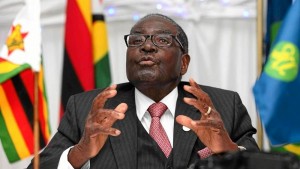
President Robert Mugabe
LAST week, President Robert Mugabe officially launched the voter registration process, a week after proclaiming the timeline for the biometric voter registration (BVR) programme.
The main opposition Movement for Democratic Change (MDC) party, led by former Prime Minister, Morgan Tsvangirai, reacted by challenging the proclamation at the court. The case is set for hearing in the High Court today.
In the Government Gazette of September 8, 2017, Mugabe published the proclamation setting September 14, 2017 to January 15, 2018 as the period that the BVR process would run.
The main opposition party argues that Mugabe should only have proclaimed the date for the registration programme after the Zimbabwe Electoral Commission (ZEC) had completed the procurement of the BVR equipment, especially the servers in which the data from the exercise would be stored.
The Luxton Group is supplying the equipment. Only 400 of the required 3000 BVR kits have been delivered, and 2 600 are pending.
A week later, Mugabe used the controversial Presidential Powers Act to make amendments to the Electoral Act via a Statutory Instrument (SI) when ideally the changes to the law should have gone through Parliament.
To add to the chaos, ZEC unveiled a schedule of voter registration centres that showed Harare (including Chitungwiza) and Bulawayo — the leading strongholds of the opposition — being allocated two and one stations, respectively, while some rural provinces had up to eight centres each.
The official position is that ZEC is not adopting anything from the controversial voters’ roll from the Register General’s office; yet at the same time it is saying it will not be conducting a delimitation exercise, but would use the electoral boundaries set using that roll. These electoral boundaries are determined by the voters’ roll that the commission says it is going to compile from scratch.
With preparations for the 2018 harmonised elections already causing acrimonious disputes between the opposition parties and Mugabe, who is always accused of tilting the electoral playing field in favour of his party, it is already doubtful if they will be different from the others that have failed to pass the credibility test.
All Zimbabwe’s major elections since 2000 when the MDC emerged on the political scene have been disputed, with the courts being flooded primarily by cases in which Mugabe and his party have been accused of employing various vote-stealing techniques that range from nuanced methods such as the use of ghost voters, use of State resources to buy votes, gerrymandering to more naked rigging processes like ballot stuffing, violence and intimidation of voters.
The failure of the March 2008 harmonised elections to produce a presidential winner resulted in a run-off poll, which was so discredited that even after being declared winner, Mugabe was unable to form a government. This resulted in the intervention of the Southern African Development Community (SADC), leading to a Global Political Agreement (GPA) of September 15, 2008 that paved way for a coalition government.
So wide was the disparity between the parties’ positions that it took another six months for the GPA to be consummated in February of 2009.
Mugabe’s latest move to use the controversial Presidential Powers Act is a repeat of what he did in June 2013 when he unlawfully proclaimed the date of that year’s harmonised elections through the same outdated law. The opposition tried to get the proclamation revoked without success, resulting in it being stampeded into an election that the ruling party was believed to have carefully planned.
After the 2013 elections that Mugabe and his ZANU-PF party won, MDC-T petitioned the courts to overturn the results on the basis of a gamut of irregularities, but later made a surprise withdrawal of the court petition.
The party explained the withdrawal to be the result of its inability to get vital information from the ZEC that it needed to back its case.
The party announced that it was going to fight for changes through various forms of protests and one of these was to boycott all elections until comprehensive electoral reforms had been made. Since then the party boycotted all by-elections, including those caused by the expulsion of 21 of its legislators — including then secretary general Tendai Biti — who had rebelled against Tsvangirai’s leadership.
Most of the electoral reforms demanded by the opposition include those that were highlighted by the SADC and African Union observer teams that covered the 2013 elections. These include State media reforms, shortcomings in ZEC’s preparations, the inability of candidates and members of the public to inspect the voters’ roll, reports of duplication of voters’ names or omission of others, publication of polling stations and the high number of assisted voters.
In addition to this, the opposition and Civic Society Organisations (CSOs) have been demanding the extension of the vote to the Zimbabwean Diaspora.
Of all electoral reforms on the opposition list, government only conceded to the introduction of a biometric voter registration system to replace the one that was inherited from Registrar General’s office. Even after government had conceded to implement the BVR system, the parties appear to be heading for a showdown, as the opposition is demanding an independent biometric technical support to verify and check the authenticity of the BVT system.
Last year, members of the opposition ganged up to form a pressure group called the National Electoral Reform Agenda (NERA), which held street protests that succeeded in shutting down the capital, Harare. However, NERA — a coalition of about a dozen opposition political parties — has since fizzled out after being slapped by a nuisance suit by a shadowy group calling itself Citizens Against Violence and Anarchy Trust. The outfit, which is fronted by a former senior police officer and whose other members include people known to be sympathetic to the ruling party, successfully approached the courts for permission to institute a class lawsuit for damages against NERA, claiming its members lost property and business during the protests.
Since ZEC announced that the 2018 elections were going to be held using a BVR voters’ roll in January 2016, CSOs demanded that voter education and other related processes start immediately, but these only started last month — some 20 months later — when the country is approaching the elections.
The CSOs, always wary of Mugabe and ZANU-PF, have raised fears that Mugabe could be behaving in this patently illegal way so that when the legality of his actions is challenged in court and it is overturned, the whole process would be nullified at such a time when there would not be enough time to start it all over again. This then would leave ZEC without a new BVR voters’ roll resulting in the elections being held under the old voters’ roll.
COMMENTS