
Following a ROHR meeting, Vigil activists met outside the Zimbabwe Embassy in London to continue our protest against the human rights abuse and lack of democracy in Zimbabwe perpetrated by ZANU PF, the ruling regime.
https://www.flickr.com/photos/zimbabwevigil/55643349559/sizes/m/
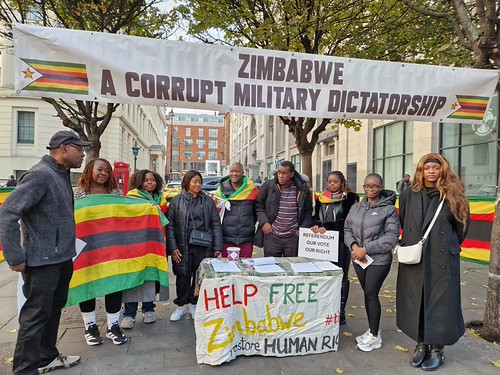
Thanks to those who came today: Brendalee Grubi, Blessing Harry, Jonathan Kariwo, Chantelle Manyande, Philip Maponga, Trish Matsikira, Pearl Michize, Tatenda Nyakudziwanza, Rumbidzai Nzvere, Mazvita Shonhiwa, Pearl Shonhiwa, Ephraim Tapa, and Talent Tsatsi. Photos: https://www.flickr.com/photos/zimbabwevigil/albums/72177720336837743/.
Vigil activist Rumbidzai Nzvere writes:
Operation Chenesa: Clearing the Poor, Not the Problem
Across Harare, families are standing beside the rubble of homes they paid for. Opposition parties say the bulldozers have now reached Mwenezi, Rutenga and Mazowe, and Harare homeowners have been told to pay penalties and the full value of their land or, if they miss a 9 November deadline, the cost of their own demolition. This is Operation Chenesa: sold as restoring order, felt as the loss of homes and livelihoods.
What is Operation Chenesa?
Chenesa means ‘clean up’ in Shona. Minister Daniel Garwe and Mayor Jacob Mafume launched the operation on 9 September with around 300 municipal police and bulldozers. By 21 September, the government’s own figures showed 2,475 businesses affected and 1,137 structures removed. Whatbegan with street vendors has spread to people’s homes.
The human cost
With formal jobs scarce, an estimated 70% to 85% of Zimbabweans survive on informal trade. Remove a stall without an alternative, and a family loses its rent, school fees and food. Many of the homes now being flattened were bought in good faith with a lifetime's savings. And many of these families were told, not long ago, that this would never happen.
Analysis: why now? The CAA3 factor
The timing of Operation Chenesa is no accident. It began just two months after President Mnangagwa signed Constitutional Amendment Act No. 3, which postponed the 2028 general election to 2030. That matters, because elections are one of the few moments when ordinary people hold real power over those who govern them.
For years, vendors and informal settlers were courted, not chased. Ahead of the 2023 elections, officials promised them protection, and vendors say Minister Garwe assured them that no government department or council would remove them while Zanu-PF was pushing the 2030 amendment through. The message was simple: this is your livelihood, and no one will take it from you. Now the amendment has passed, and the message has turned around. With no national vote for at least another four years, the political cost of bulldozing a market or a neighbourhood has fallen sharply.
Those in power no longer need the votes, the rally crowds or the goodwill of the people whose homes are coming down. This is the real danger of removing elections from the calendar. Accountability does not only happen at the ballot box, but the ballot box is what makes leaders listen. Take it away, and promises made to the poorest citizens become easy to break. Operation Chenesa shows what governing looks like when those in power believe they have nothing left to fear. The government will say the two are unrelated. But the people standing in the rubble remember who promised them safety, and when.
Emptying the cities ahead of a court ruling?
Minister Garwe has already said it out loud. Touring cleared sites in September, he hinted at a bigger plan still to come and told reporters: ‘We will now come and remove people. They must go back to their homes.’ Harare Mayor Jacob Mafume has reportedly suggested that residents who cannot afford the capital should leave it. Zimbabweans heard the same in 2005, when Operation Murambatsvina left about 700,000 people without homes or livelihoods and the displaced were told to return to their rural homes.
One analyst warned the aim was to depopulate urban areas, the opposition’s heartland, before the next election. That matters now because CAA3 is not yet safe from the courts. On 2 November, the Constitutional Court reserved judgment in a war veterans’ challenge, and the MDC has a separate urgent application. If the amendment falls, the 2028 election could return. We cannot prove intent. But scattering urban communities while that ruling is pending looks less like town planning and more like insurance.
What the law says
Section 74 of Zimbabwe’s Constitution forbids evicting anyone or demolishing their home without a court order. In 2024, the High Court also ruled against provisions that councils had used to issue demolition orders.
What we are calling for
Restoration of Human Rights Zimbabwe calls on the Government of Zimbabwe to: • Halt all demolitions carried out without a court order, as Section 74 requires • Provide alternative housing and trading sites before anyone else is moved • Pursue the land barons who sold stands illegally, not the families who bought them We ask the UK government to raise these evictions with Harare, and our readers to share this article and write to their MPs. Clean streets mean nothing if the people who live on them have nowhere to go.
Sources • CITE: Operation Chenesa sparks Murambatsvina comparisons • ZimDaily: Six in ten losing homes are Zanu PF supporters, says opposition • ZimEye: Garwe faces 7-day resignation ultimatum • NewZimbabwe: Government gives in as vendors resist • The New Humanitarian: Survival after Operation Murambatsvina • CBS News: Zimbabwe demolishes rural homes (2005) • The Zimbabwean: ConCourt reserves judgment in CAA3 challenge • Zimbabwe Situation: Minister Garwe vows to keep Harare clean • Maravi Post: Harare mayor tells poor to leave city For Vigil pictures check: http://www.flickr.com/photos/zimbabwevigil/. Please note: Vigil photos can only be downloaded from our Flickr website.
Events and Notices: Next Vigil meeting outside the Zimbabwe Embassy.
Saturday 21st November from 2 – 5 pm. We meet on the first and third Saturdays of every month. On other Saturdays the virtual Vigil will run.
The Restoration of Human Rights in Zimbabwe (ROHR) is the Vigil’s partner organisation based in Zimbabwe. ROHR grew out of the need for the Vigil to have an organisation on the ground in Zimbabwe which reflected the Vigil’s mission statement in a practical way. ROHR in the UK actively fundraises through membership subscriptions, events, sales etc to support the activities of ROHR in Zimbabwe.
The Vigil’s book ‘Zimbabwe Emergency’ is based on our weekly diaries. It records how events in Zimbabwe have unfolded as seen by the diaspora in the UK. It chronicles the economic disintegration, violence, growing oppression and political manoeuvring – and the tragic human cost involved. It is available at the Vigil. All proceeds go to the Vigil and our sister organisation the Restoration of Human Rights in Zimbabwe’s work in Zimbabwe. The book is also available from Amazon. Facebook pages: Vigil : https ://www.facebook.com/zimbabwevigil ROHR: https://www.facebook.com/Restoration-of-Human-Rights-ROHR-Zimbabwe-International-370825706588551/
The Vigil, outside the Zimbabwe Embassy, 429 Strand, London meets regularly on Saturdays from 14.00 to 17.00 to protest against gross violations of human rights in Zimbabwe. The Vigil which started in October 2002 will continue until internationally-monitored, free and fair elections are held in Zimbabwe.
COMMENTS