
Source: Korea donates rehabilitation equipment for children with cerebral palsy – herald
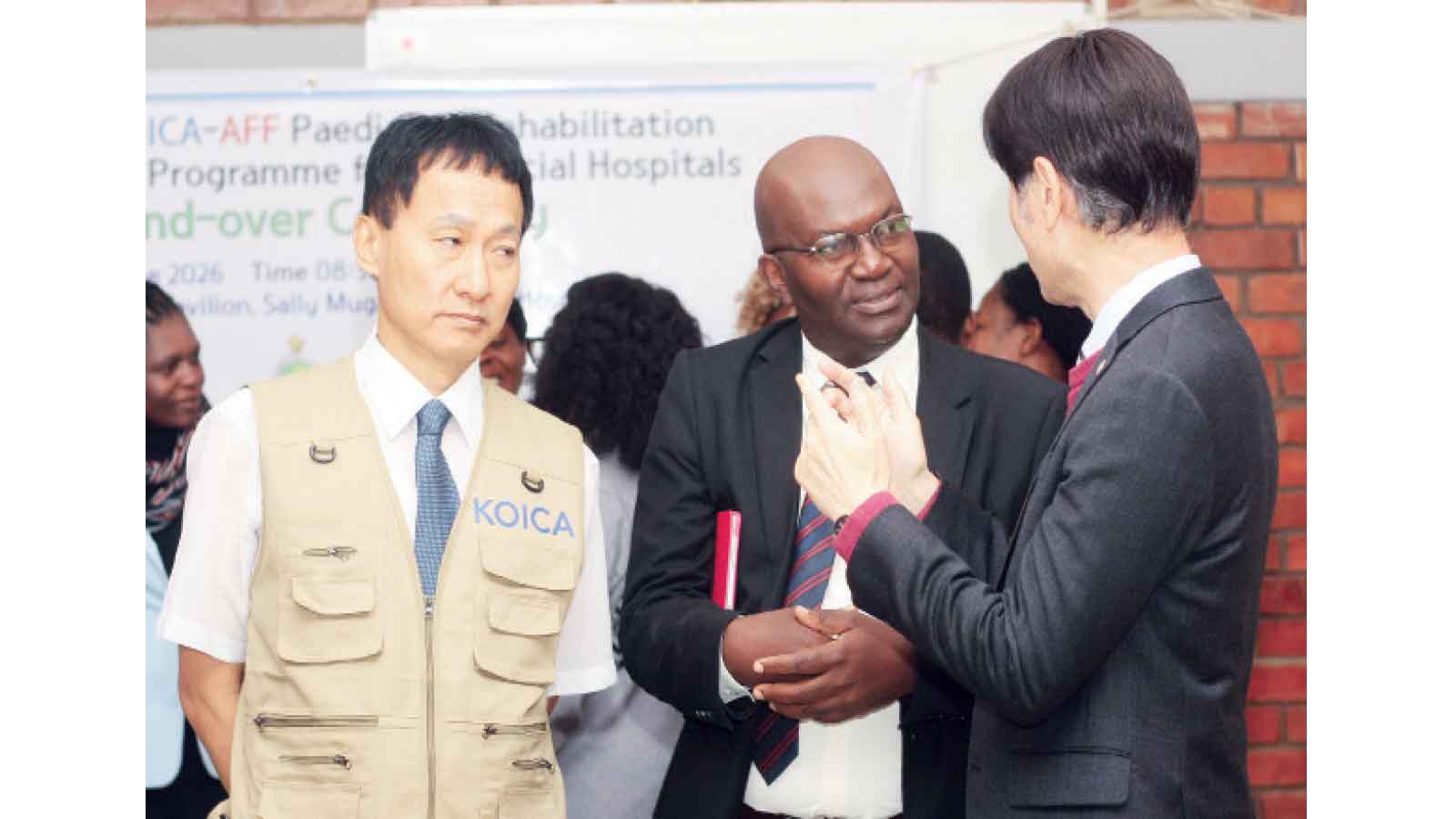 Sally Mugabe Hospital Clinical Services Director Dr Hopewell Mungani (centre), flanked by the Ambassador of the Republic of Korea to Zimbabwe Mr Jae Kyung Park (right) and Mr Sikhyeo Kim of the KOICA Tanzania Office (left), at the handover of equipment for the Paediatric Rehabilitation Empowerment Programme for provincial hospitals in Harare yesterday. – Picture: Munyaradzi Vunganai.
Rumbidzayi Zinyuke-Senior Health Reporter
ZIMBABWE has received children’s rehabilitation equipment worth over US$170 000 from the Korean government and the Africa Future Foundation, in a move expected to strengthen specialised care for children living with cerebral palsy across five provincial hospitals.
The equipment was officially handed over at the Children’s Rehabilitation Unit at Sally Mugabe Central Hospital yesterday, marking another milestone in the long-standing partnership between Zimbabwe and the Republic of Korea to improve paediatric rehabilitation services.
Permanent Secretary for Health and Child Care Dr Aspect Maunganidze, who was represented by Sally Mugabe Central Hospital Chief Medical Officer Mr Hopewell Mungani, said the donation would improve access to quality rehabilitation services while empowering health workers and caregivers.
“Today (yesterday) marks another significant milestone in our journey towards accessible, high-quality healthcare for every child in Zimbabwe,” he said.
“This generous contribution from KOICA and the Africa Future Foundation directly strengthens our healthcare system.
“On behalf of the government of Zimbabwe, I extend our heartfelt gratitude to KOICA and AFF.
“Your unwavering generosity directly strengthens our health care system.”
Dr Maunganidze said the current phase of the programme builds on work that began at Sally Mugabe Central Hospital in 2019 before expanding to Bindura and Gwanda provincial hospitals.
The third phase has now extended support to Chitungwiza, Mutare, Chinhoyi, Masvingo and Gweru provincial hospitals, creating a wider national network for paediatric rehabilitation services.
The specialised equipment would improve clinical outcomes for children with cerebral palsy by enabling modern therapeutic interventions, while also boosting the morale of rehabilitation professionals through access to better tools.
Dr Maunganidze said children with cerebral palsy will now access high-standard specialised therapeutic interventions, vastly improving their physical development and quality of life.
“Boosted staff morale. Our dedicated rehabilitation clinicians and therapists are being equipped with the modern tools they need, renewing their passion and efficiency in the workplace.
“This initiative also equips mothers, fathers and guardians with the knowledge and resources to safely care for and support their children at home, fostering a strong community support system,” he said.
Dr Maunganidze also called for the partnership to be expanded to five more institutions including Mpilo Central Hospital, United Bulawayo Hospitals, Marondera Provincial Hospital, St Luke’s Hospital and Ruwa National Rehabilitation Hospital, to ensure more children benefit from specialised rehabilitation services.
Families whose children have undergone rehabilitation programmes supported by Korea say the intervention had brought significant improvements to their children’s mobility and overall development.
Mrs Joyce Chinofura said her son’s quality of life had significantly improved after undergoing rehabilitation.
“My son was diagnosed with cerebral palsy when he was just three months old and we started coming for rehabilitation sessions.
“He began catching up with other children of his age and now he can walk, speak, go to school and even play soccer.
“I am grateful for the services we received here at Sally Mugabe Hospital,” she said.
Another parent, Ms Eunice Jimion, said access to rehabilitation services and specialised equipment had given her child a better chance at achieving developmental milestones.
“I am happy with the progress that I have seen in my child since we started rehabilitation. I am now confident that her life will be as normal as any other child’s,” she said.
Korea Ambassador to Zimbabwe Mr Jae Kyung Park said the initiative was about transforming lives rather than simply donating medical equipment.
“This is not about the handover of equipment. Basically, it is about the people,” he said.
He said the project’s emphasis on training, education and capacity building would ensure children receive continuous care from skilled professionals and their families.
“I can feel that children need early and continuous care.
“Together with the equipment, there should be continuous care from medical professionals and also from their parents so they can have a better life, better education and better opportunities in the years ahead,” said Ambassador Park.
He reaffirmed the Korean government’s commitment to supporting Zimbabwe’s health sector through the Korea International Cooperation Agency (KOICA) and the Africa Future Foundation.
He added that humanitarian assistance should transcend political differences, saying partnerships focused on improving people’s lives remained central to Korea’s cooperation with Zimbabwe.
The latest donation forms part of an ongoing programme aimed at strengthening rehabilitation services for children with cerebral palsy through the provision of specialised equipment, training of rehabilitation professionals and support for caregivers across the country.
Newer Post
Zimbabwe joins emergency Ebola Summit Older Post
Rutenga to host 2027 Uhuru celebrations
COMMENTS