
Source: Govt unveils $80m plan to avert water crisis in Greater Harare – herald
Remember Deketeke
Herald Correspondent
GOVERNMENT has stepped up measures to prevent a water crisis in greater Harare as residents grapple with acute shortages and failing sewer infrastructure.
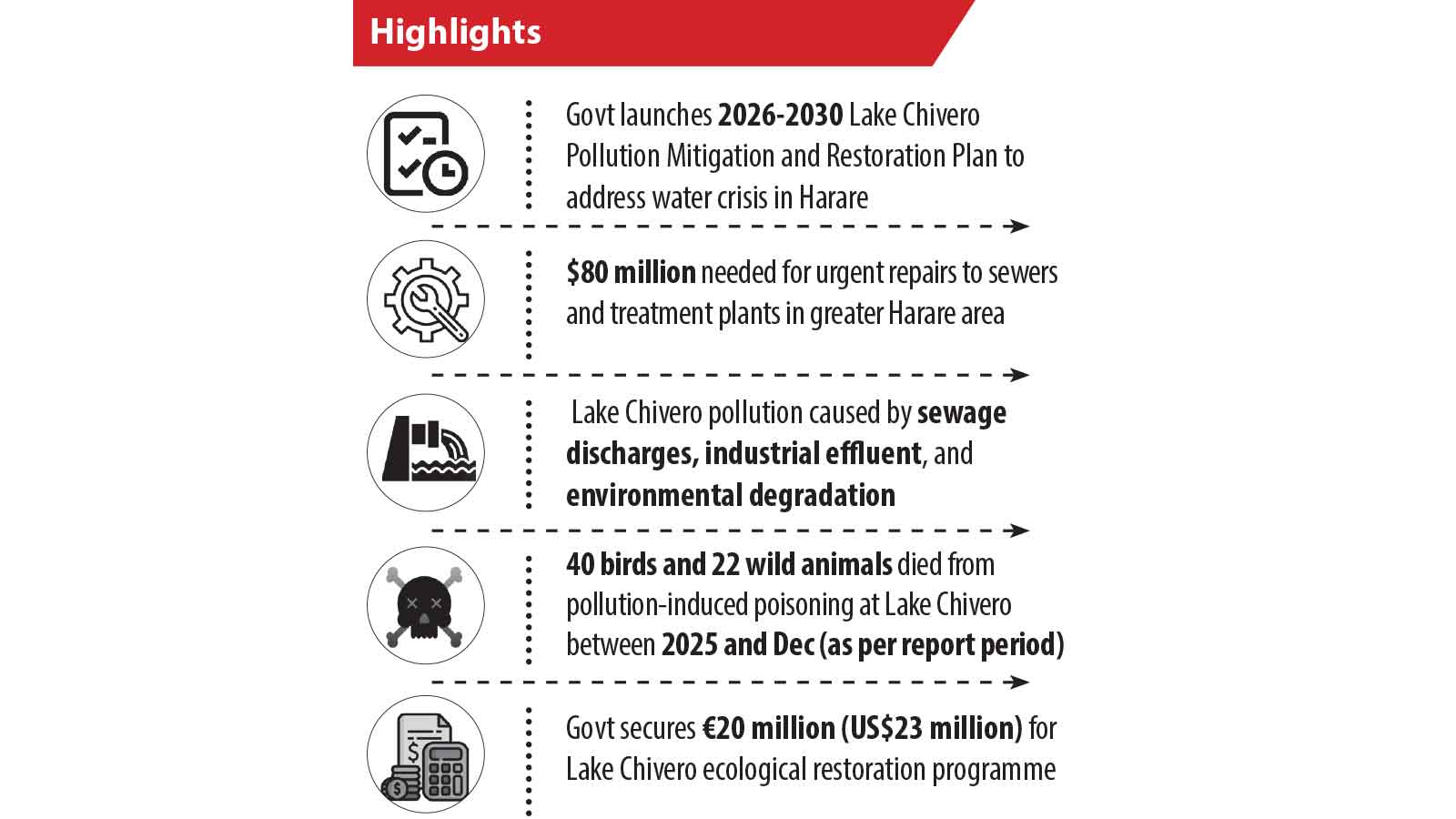
Yesterday, Government rolled out a comprehensive 2026–2030 Lake Chivero Pollution Mitigation and Restoration Plan, with support from the International Union for Conservation of Nature (IUCN). Lake Chivero supplies potable water to millions of residents in the capital and surrounding areas.
To address this, the Government has directed local authorities to prioritise the $80 million-plus needed for urgent repairs to sewers and treatment plants in the greater Harare area, which includes Harare, Chitungwiza and Ruwa.
This also comes as some local authorities were partnering private sector entities to improve service delivery and tackle water challenges.
In 2024, greater Harare’s main water was declared to be at a critical ecological failure point that posed a serious threat to water security, public health and biodiversity, leading to the latest measures.
The intervention adopts an “All-Manyame Catchment” approach, acknowledging that pollution at Lake Chivero was driven by systemic and multi-sectoral pressures, including sewage discharges, industrial effluent and upstream environmental degradation, and required coordinated action by central Government, local authorities, regulators, the private sector and surrounding communities.
Environment, Climate and Wildlife Permanent Secretary Ambassador Tadeous Chifamba said the plan will coordinate action across Government ministries, local authorities, regulators, the private sector and communities.
“In 2024, Lake Chivero reached a critical failure point, threatening the health, livelihoods and water security of more than two million residents,” he said. “The new plan aims not only to restore the lake’s ecological integrity but also to safeguard public health, biodiversity and local economic activity.”
Ambassador Chifamba emphasised the importance of translating international commitments into practical, measurable action at the catchment level.
“The Tripoli Declaration gave Africa unity. COP15 gave us global commitments. The Ramsar Legacy Strategy gives us a pathway for delivery,” he said. “If we act together, across institutions, sectors and communities, we can restore Lake Chivero, secure our wetlands and demonstrate African leadership in global environmental governance.”
Environmental Management Agency (EMA) Environmental Quality manager Mr Alpha Tarusenga Chikurira said rapid urbanisation, ageing infrastructure and population growth had overwhelmed sewage treatment systems.
“Some plants are operating at 65 percent capacity or less, resulting in large volumes of poorly treated wastewater being discharged into the environment,” he said. “Some of the facilities designed for 10 megalitres per day now receive more than 15 megalitres.”
He said many local authorities were discharging effluent in the red category or beyond legally permissible limits.
“In many instances, the quality of effluent exceeds even the red-class limit, which constitutes an excessive risk to the environment,” he said. “This is a serious concern, especially in areas that have previously been identified as cholera and typhoid hotspots.”
ZimParks aquatic ecologist for Chivero, Mr Goza David, said at least 40 birds and 22 wild animals have died from poisoning at Lake Chivero between the start of 2025 and December. These deaths, he added, were directly linked to pollution-induced poisoning in and around the lake.
“From the start of 2025 until December, we recorded the deaths of 40 birds and 22 wildlife animals due to poisoning at Lake Chivero,” said Mr Goza. “Most of these mortalities occurred within a 500-metre radius of the lake, showing a clear link between water quality and wildlife health.”
Last month, the Government secured about €20 million (US$23 million) to fund a major ecological restoration programme for Lake Chivero.
Newer Post
Harare major road rehab commences Older Post
Police ban machetes, spears in Chipinge
COMMENTS