
Source: Our personal account of the Lake Kariba tragedy
Jason and I have put this together while the events are still fresh in our minds. We wanted to share what we personally saw and experienced during the early stages of the rescue. This is only our perspective on one part of a much larger operation involving many people.
On Tuesday, 11 August, we were on board the houseboat Shawira in Gordon’s Bay. We were supposed to be moving that morning, but our captain, Captain Collins, had serious concerns about the conditions on the lake. The wind was blowing very strongly up the lake from the Binga side and the water was extremely rough. The weather apps we were using were showing winds of around 19 mph.
At around lunchtime, a distress call came through.
At the time, we had very little information about what had happened. We assumed it was probably a houseboat in trouble with perhaps 20 people or fewer on board.
We had a private speedboat available(thank you Howard Vermaak), so Jason Corbett, Captain Collins and I left almost immediately to assist. We loaded approximately 20 life jackets, a bit of extra fuel and headed out.
In the distance, we could see the MAPS helicopter hovering over the water and understood that must be where the incident had occurred.
The conditions were probably the worst I have personally experienced on Lake Kariba. It was very rough water and a difficult crossing. It took us roughly 20 minutes to reach the scene.
When we arrived, we immediately realised this was nothing like what we had expected.
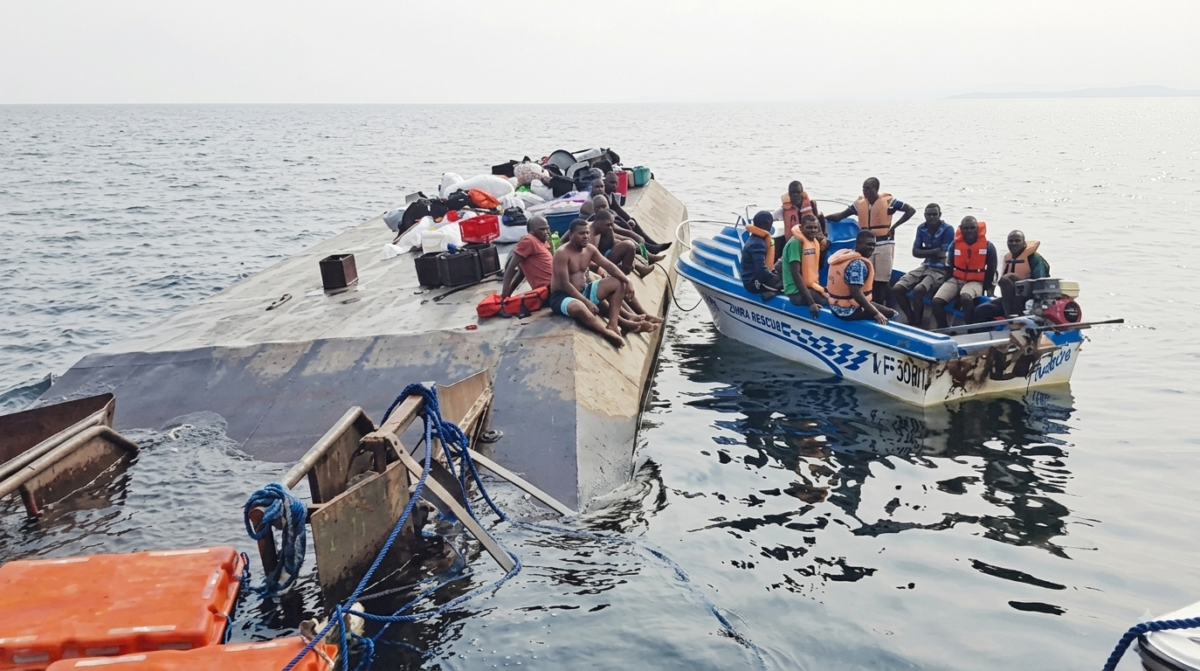
A ferry had capsized and there were numerous people, some with life jackets and some without, sitting on the overturned hull. There were life jackets, life rafts and a large amount of debris floating all around the scene.
From our recollection, one speedboat with two people aboard was already taking survivors off the ferry. There was another speedboat being operated by its pilot alone, so Jason immediately transferred across to assist him.
Shortly afterwards, we noticed a National Parks boat assisting as well. A short distance away, the houseboat Lady May was also providing assistance.
Our immediate priority was to get flotation to the survivors who didn’t have any. We had no idea how long the overturned hull would remain afloat, so we started trying to hand out the life jackets we had brought with us.
While doing this, I noticed someone in the MAPS helicopter urgently pointing towards an area of water away from the ferry. The helicopter came down low and continued directing us towards something in the water.
Captain Collins and I immediately went towards where they were pointing, believing they had spotted another survivor.
When we reached the position, we found a person unresponsive in the water. We pulled him into our boat, but sadly it was already too late.
There were still many people who needed help, so we returned to the overturned ferry and continued distributing life jackets to those without flotation.
We then took approximately eight or nine survivors aboard our boat. Among them was a very young baby, perhaps six months to a year old.
The baby’s mother handed the child to us and then moved back to allow other people to get onto the boat. We later understood that she also made it off the ferry on another rescue boat, although we cannot personally confirm this.
Once our boat was loaded, our priority became getting those people somewhere safe. I initially piloted towards Lady May, hoping we could drop the survivors there and return to the ferry for more.
When we reached Lady May, however, she already had a number of survivors aboard and could not safely take any more. We were directed towards Long Island instead.
The journey to Long Island took us roughly another 15 minutes in extremely difficult conditions.
We arrived at around the same time as the National Parks boat and the speedboat Jason was assisting on.
Jason’s boat had rescued a further five people, including two children. With Jason and Morgan, the speedboat pilot from Lady May, aboard, the boat was at capacity and could not safely take any more survivors.
The National Parks team began counting survivors as they arrived.
We had been on Long Island for approximately another 20 minutes when more rescue boats began arriving with survivors. Fothergill was one of the boats we remember arriving, along with another National Parks boat and the boat we now understand took some of the footage that has subsequently circulated.
From our recollection, according to the National Parks count at that stage, there were approximately 48 survivors with us on Long Island and another 12 aboard Lady May. Together, that was around 60 survivors accounted for in those two locations, as well as the deceased person we had recovered.
The helicopter from Matusadona then landed close by. I spoke briefly with the person who had directed us towards the person in the water. They told me that other boats were now on scene assisting as well. At that point, there was not much more we could do.
We were later told that the person we had recovered from the water was the captain of the ferry, although we have not personally confirmed this.
By the time much of the footage now circulating on social media was recorded, a number of survivors had already been taken from the overturned ferry and transported away from the scene.
The footage is extremely distressing and captures both the tragic loss of life and the rescue efforts still underway. With the greatest respect for everyone involved, it represents one stage of a much larger rescue operation involving many people, some of whose efforts were never captured on camera.
There were many other people involved in the rescue, and they will have their own experiences and perspectives.
The accident occurred a considerable distance from the mainland harbours and, given the conditions on the lake that day, reaching the scene took time. We were fortunate to already be relatively close and to have boats and life jackets available.
What stood out to us was how quickly people responded in treacherous conditions, putting themselves at risk to help people in need.
Sadly, we now know the enormous loss of life that occurred. Our thoughts are first and foremost with the families who lost loved ones, the survivors, and everyone affected by this terrible tragedy.
We are grateful that we were in a position to help some of those who survived, and humbled by all those who took risks to assist.
May those who perished forever rest in peace. – Allan Wheeler
COMMENTS