
Situation Report in English on Zimbabwe and 1 other country about Food and Nutrition, Health and more; published on 13 Jul 2026 by IFRC
Source: Zimbabwe Population Movement 2026 – DREF Operation (MDRZW028), 13 July 2026 – Zimbabwe | ReliefWeb
Description of the Event
Date when the trigger was met
25-06-2026
What happened, where and when?
The ongoing situation involves the large-scale return of Zimbabwean nationals from South Africa following a sharp escalation of localised violence targeting foreign nationals between March and June 2026. The violence, concentrated in major urban centres including Johannesburg, Durban, Cape Town, and parts of KwaZulu-Natal and the Eastern Cape (including Port Elizabeth), resulted in intimidation, displacement, loss of access to basic services, and heightened insecurity among migrant communities, prompting large-scale voluntary and assisted return movements to Zimbabwe. According to the Department of Immigration, a total of over 40,198 Zimbabwean returnees has self-repatriated since 28 May 2026, including 4,795 migrants who have been assisted through the State-assisted repatriation program (as of 27 June 2026).
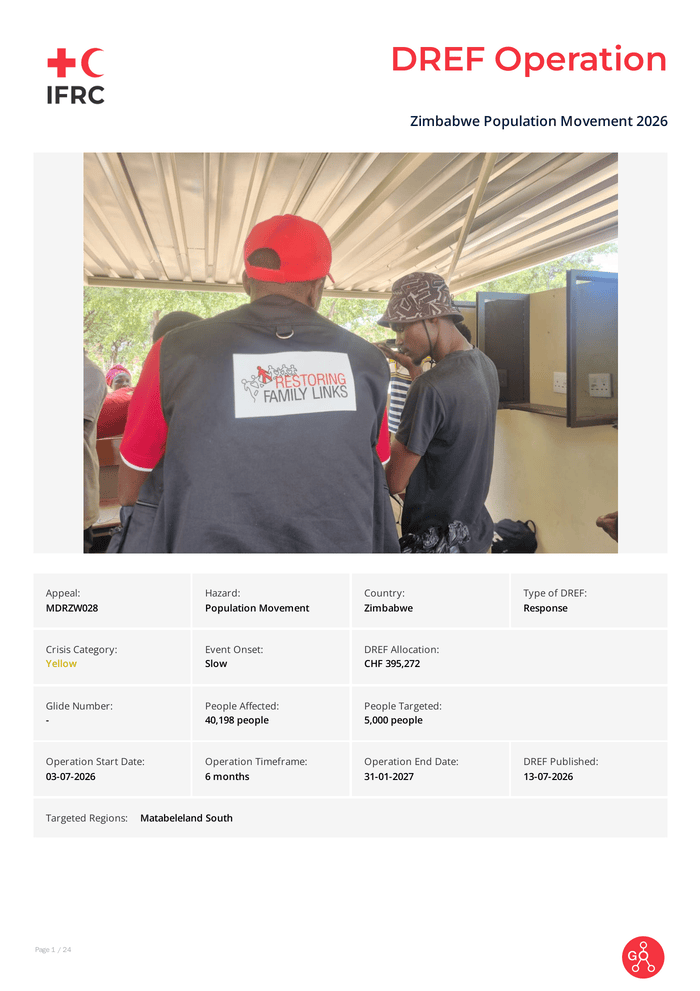
The primary entry point and reception area is Beitbridge Border Post in Matabeleland South Province, Zimbabwe, where returnees are processed at the Beitbridge Reception Centre before onward movement to their areas of origin across the country, including Harare, Bulawayo, Manicaland, Masvingo, Midlands, Mashonaland East, Mashonaland West and Mashonaland Central Provinces.
The violence escalated between March and June 2026, with return movements beginning in late May 2026 and continuing to date. The Government of Zimbabwe has convened a series of coordination meetings at national and district levels to manage and coordinate assistance for returning migrants, including an interministerial meeting held on 27 May 2026, during which the Department of Immigration reported the consolidated statistics on return movements. Although returns have been ongoing over several months, the current phase of sustained high-volume arrivals, combined with winter conditions, makes this the appropriate time for DREF activation, as humanitarian needs have intensified due to prolonged waiting times, overnight stays at the reception centre, and exposure to low temperatures.
COMMENTS