
Source: Mugabe in Presidential Powers climb down | The Financial Gazette September 28, 2017
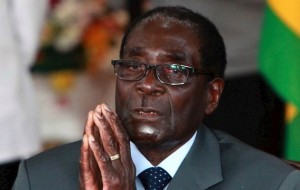
President Robert Mugabe
PRESIDENT Robert Mugabe’s government has gazetted a Bill to rectify the amendment of the Electoral Act, in a move that amounts to an admission that the use of Presidential Powers Act to amend laws is unlawful.
This followed warnings by legal experts who raised the red flag on his use of the questionable powers to amend the Electoral Act, a move they said could jeopardise the whole electoral process. The Presidential Powers (Temporary Measures) (Amendment of Electoral Act) regulations were gazetted on September 15 in the Government Gazette (Statutory Instrument 117/2017) in which Mugabe made several changes to the electoral law. Legal experts immediately pointed out that, while the changes that Mugabe sought to make were necessary, it was the illegal process through which the changes were made that was a cause for concern.
Lawyers have repeatedly pointed out that the Presidential Powers (Temporary Measures) Act is inconsistent with the present Constitution and, therefore, became unconstitutional and invalid as soon as the Constitution came into full operation on August 22, 2013, which renders any regulations made under the Act and anything done under such regulations open to a Constitutional challenge in the courts. In the past, Mugabe has used Presidential Powers to circumvent the legislature.
Under the new Constitution, the powers should be used sparingly, in rare cases of emergencies. The amendments seek to smoothen the voter registration process, facilitate transfer of voters from one constituency to another, ban the use of the controversial voter registration slips by people not appearing on the voters’ roll to vote on polling day, as well as to make everyone go through the process of registering afresh regardless of whether they have been registered before, among other things.
Although these issues have been raised by Civil Society Organisations (CSOs) since the new Electoral Act came into effect 2013, Mugabe only waited until a fortnight ago to make the changes through the Presidential Powers Act, whose legality is subject to contestation. “It is unfortunate that the Government has seen it fit to resort to the questionable authority of the Presidential Powers (Temporary Measures) Act to make these important changes to the electoral law,” said Veritas, a Zimbabwean legal and legislative watchdog.
“The Veritas position is, and has been since 2013, that the Presidential Powers (Temporary Measures) Act is unconstitutional in its entirety and therefore invalid, making regulations under the Act also invalid. But the Government does not agree and it has continued to use the Act to gazette regulations covering a fairly wide range of controversial issues; it seems determined to treat the Act as valid law until a court decides otherwise.” The watchdog said so far no person or organisation has successfully challenged Mugabe’s use of the out-dated law that was provided for in the old Constitution, but if successfully challenged, the result could be the nullification of everything that would have flowed from that illegal process.
The use of Presidential Powers to amend an Act is seen as unconstitutional as it violates the doctrine of the separation of powers by giving the executive powers to usurp Parliament’s primary law-making function. “The Presidential Powers (Temporary Measures) Act not only delegates primary law-making power to the President, but also fails to specify the nature and scope of regulations that may be made under the Act or the principles and standards applicable to them. It is therefore unconstitutional and invalid,” Veritas added. Constitutional lawyer Greg Linnington concurred with Veritas, saying: “I believe the Presidential Powers Act is unconstitutional.
Section 134(a) of the Constitution says that ‘Parliament’s primary law-making power must not be delegated’. The Presidential Powers Act delegates primary law-making powers to the President, thus it must be unconstitutional. Primary law-making power is the power to make laws equivalent in status to an Act of Parliament … section 157 of the Constitution … says electoral law must be made by an Act of Parliament. Thus, only Parliament can make electoral law. The President cannot make it.”
Upon noticing that it had bungled the amendment process, the government on September 18 published the Electoral Act Amendment Bill in an extra-ordinary Government Gazette. The Bill is almost identical in wording to SI 117/2017. The only point of difference is in clause 4, which now has an extra subclause backdating amendments to section 36A of the Electoral Act dealing with the re-registration of existing voters; the backdating is to September 12, the date the present voter registration exercise started, as ordered by Mugabe in SI 109/2017.
Although neither the Bill itself nor the explanatory memorandum published with it explains this, the purpose of the Bill is clearly to give a constitutionally sound basis to the process of making amendments to the Electoral Act, instead of the questionable method of making them by the Presidential Powers. There are, however, still concerns that the Bill falls short of addressing all the electoral concerns that have been raised by stakeholders as necessary to bring the Electoral Act into line with the Constitution and international best practice. newsdesk@fingaz.co.zw
COMMENTS