
Source: Zimbabwe targets one million tonnes winter crops, programme to ensure food self sufficiency – herald
Elita Chikwati and Edgar Vhera
GOVERNMENT has set a target of 951 350 tonnes of food crops for the upcoming 2026 winter cropping season.
The targeted production aligns with Government’s inward-looking policies to achieve self-sufficiency in view of global food supply disruptions due to global conflicts in Eastern Europe and the Middle East.
Zimbabwe has been registering growth in the agriculture sector since the implementation of the National Development Strategy 1(NDS1).
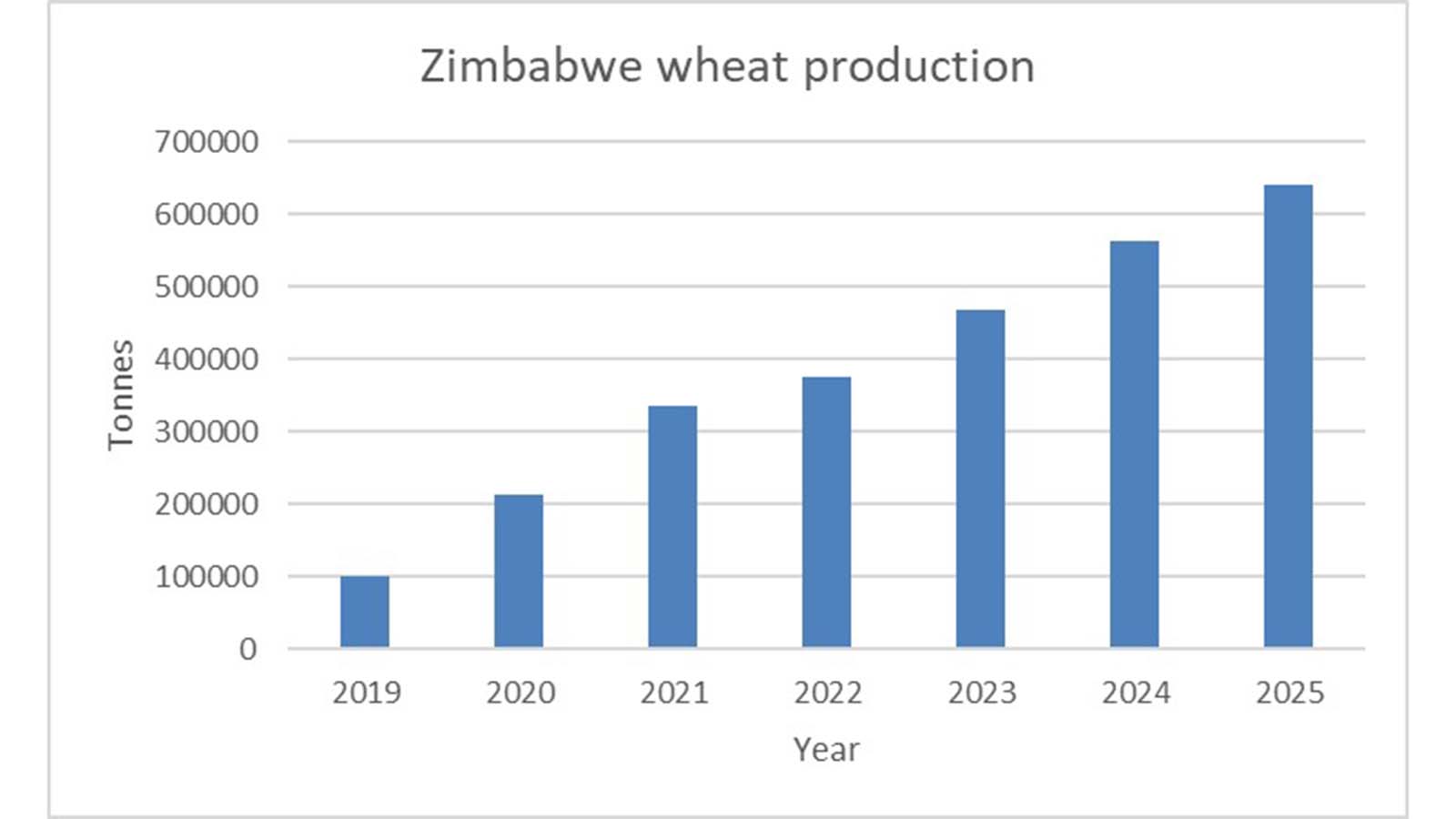
Under NDS1, agriculture productivity rose outside the El Nino induced drought years, with maize output rising to a peak of 2.7 million tonnes in 2021, while wheat production achieved national self-sufficiency of 375 000 tonnes in 2022 and rising to 640 000 tonnes last year with growing prospects during NDS 2 of exporting surpluses to the region.
The NDS 2 seeks to ensure food and nutrition security through increased agricultural productivity, modern storage infrastructure and enhanced climate resilience.
Focus will also be on promoting climate-smart agriculture, sustainable irrigation and integrated land and water management.
Cabinet recently approved the 2026 Winter Production Plan, which will see the country producing 662 000 tonnes of wheat, surpassing the national annual requirement of 360 000 tonnes.
Barley production is projected to rise to 45 500 tonnes, while Irish potatoes production is projected to reach 243 850 tonnes.
A comprehensive whole-of-Government and sector approach will be employed to achieve the set targets.
During the recent post Cabinet briefing, Minister of Information, Publicity and Broadcasting Services, Dr Zhemu Soda, said this year’s winter plan was targeted at supporting national development by focusing on wheat, Irish potatoes and barley production.
“Building on the successes of the two previous seasons and record wheat production in 2025, the plan promotes rural industrialisation through value addition across the entire agricultural value chain.
“The plan aligns with Agriculture Food Systems and Rural Transformation Strategy 2 (AFSRTS 2) pillars that include sustainable production, climate resilience, rural industrialisation, market development and infrastructure enhancement,” he said.
Dr Soda revealed that the available area for winter irrigation is estimated at 256 958 hectares, with 140 500 hectares designated for the production of wheat, Irish potatoes and barley.
“Specifically, wheat will be cultivated on 125 000 ha, barley on 6 500 ha, and Irish potatoes on 9 000 ha.
Government has put in place measures to ensure a successful implementation of the Plan by closely monitoring 21 critical enablers, including essential resources such as power, water, seed, fertiliser and fuel.
“Financial support mechanisms encompassing farmer payments, financing and insurance; operational efficiency factors like mechanisation, coordination and contract farming; risk management strategies addressing migratory pests, land issues, security and veld fire management; capacity building, policy and regulatory frameworks, soil management, marketing and monitoring and evaluation will be tracked,” he said.
A strong signal has been sent with the country recently receiving a new consignment of agricultural machinery from Belarus under the third phase of the Zimbabwe-Belarus Agricultural Mechanisation Programme.
More than 300 tractors and 62 combine harvesters have arrived in the country, supplementing equipment already deployed under the programme since its launch in 2021.
Agricultural Engineering, Mechanisation, Farm Infrastructure Development and Soil Conservation chief director, Engineer Edwin Samuel Zimunga, said the machinery would support harvesting operations and preparations for the upcoming winter wheat season.
“The mechanisation programme is ongoing and this new fleet of machinery secured under the third phase will go a long way to complement the other consignments secured since the launch of the programme in 2021.
“We urge farmers to approach the banks mandated to distribute this equipment. They are ready for use to clear maize and ensure farmers plant wheat on time,” he said.
The value chain should continue to work together in a co-ordinated manner to ensure the linkages are strengthened by ensuring that the wheat value chain is highly-dependent on locally-produced crop.
Currently wheat production is financed under the Presidential Inputs Scheme, National Enhanced Agricultural Productivity Scheme, Agriculture and Rural Development Authority (ARDA), Joint Ventures (JVs) and private sector schemes.
The country requires 360 000 of wheat annually and has been self-sufficient from local production since 2022 when 375 000 tonnes were harvested.
The current push by the Second Republic now is to substitute imports with locally produced wheat products and explore wheat exports to generate foreign currency.
Under AFSRTS 2 wheat production is projected to rise to 1 388 000 tonnes by 2030, while the gross value will increase from US$342 million to US$541 million.
The wheat value chain’s contribution at inception of AFSRTS 2 will be three percent of total Agriculture Gross Value in 2026 and rise to 3.4 percent in the 2030 season.
Wheat is mainly used as a human food in the form of bread, paste products, breakfast cereals, cake and many others. It is an active contributor to the country’s gross domestic product (GDP).
Over the years, demand for wheat has been rising due to increases in population growth, urban populations and changes in consumer tastes and preferences, thereby outstripping supply.
This necessitated imports to fill the gap while hard wheat was also required to improve the glistening of the local wheat product.
Wheat imports involve the expenditure of foreign currency, hence the call by Government for farmers to increase production is a healthy way of import substitution.
The private sector was also tasked by Government to contribute at least 40 percent of the production of their raw material requirements.
Government’s call for import substitution through local production has also resulted in 100 percent increase in homegrown table potato cultivation as farmers collaborate with agro-processors through off take arrangements for enhanced production, market access and sustainability.
This was after potato was declared a strategic crop to enhance food security at household and national level and instituted a number of measures chief among them a ban on table potato imports since 2010.
This was a deliberate measure with the objective of protecting the local potato farmers from unfair competition from cheap imports from neighbouring countries.
Government allowed supervised importation of certified potato seed by seed houses to complement local seed production.
The import of potato seed is projected to go down as the US$800 000 Kutsaga Tissue Culture Facility expands the production of disease free seed.
Kutsaga said the facility was playing a pivotal role in advancing national self-sufficiency in Irish seed potato production.
“To date some three million G0 mini-tubers translating to 12 million G4 seed potato tubers have been produced.
“As production is scaled up, this initiative is expected to significantly reduce reliance on imported seed potato, thereby lowering production costs and enhancing local value chains,” said Kutsaga Research Institute executive director production and operations, Mrs Rhoda Mavuka during commissioning of the plant.
Kutsaga’s main focus is to increase the number of Irish potato varieties available to local and regional farmers from the current six (Diamond, Hermes, Valor, Mondial, Avalanche and Jasper).
The area under potato production also rose 111 percent from 11 600 hectares in 2013 to 23 982 in 2023.
COMMENTS